


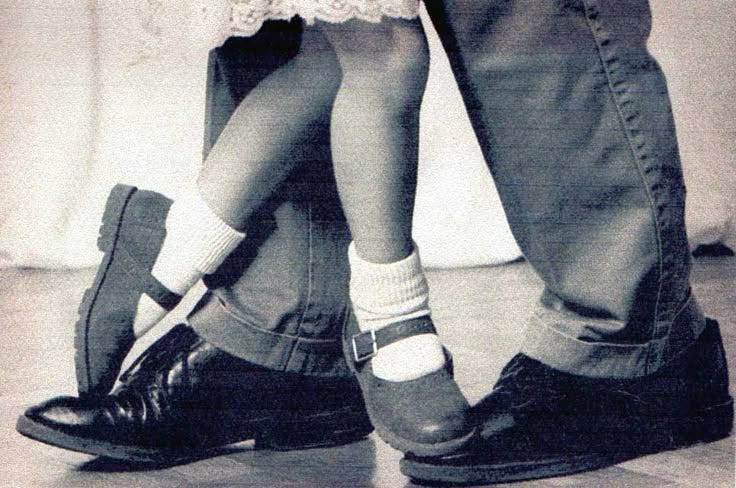
When I was seven, a bee flew into my ear. My mother was at work. The driver had the car. My father bundled me into a rickshaw and took me to the nearest hospital. My first time riding one.
My mother being a well-known pediatrician, people knew us. My father, therefore, swept past reception, skipped triage, and took me directly to the head of ENT. The doctor, nurses, and Abbu surrounded me. Someone brought in the instruments. Out came the bee. Dead.
“What!” Abbu said, leaning over the metal basin where the bee lay, as if inspecting a great tragedy. “Ei moumachi to more gese! Ai hai! The bee died?!” The nurses began to giggle. The doctor laughed.
Still reeling from the silence that had taken over me when the bee went in, I tore my eyes away.
“Tsk tsk tsk, bechara moumachi,” my father went on, shaking his head and turning to the room as though addressing an audience. “Doctor, why didn’t you save it?”
They laughed.
He told the story on the way home. Then my mother (who stared at us with her mouth open). Then to just about everyone we knew. By the time the tale of the poor, dead bee — and “the highway to the danger zone” that was my ear canal — spread across calls, across rooms, across town, my father looked quite pleased with himself.
Abbu carried a light breeze. Visibly lightening the load of those around him. Hardly anything phased him. On road trips, if a car came up behind us trying to take over, he’d slow down and wave it past with vehement politeness as though he were hosting them. “Jaan bhai, jaan,” he’d say. “Please, go first. I am in no hurry.” We would laugh uncontrollably.
“Go. You go. Everyone go.”
As Stevie Wonder blared on the radio, he’d take his hands off the wheel — far longer than necessary — and clap in beat, flashing me a broad, clownish grin.
If words of affirmation were your only love language, it might be difficult for you to make a relationship work with a typical Bengali person. We don’t use the words. There are no declarations, no apologies stated plainly, and no habit of thanks. The good is that we learn to detect love expressed in many forms. Plates of food appearing without being asked for. Someone waiting up. Someone noticing when you are not yourself. Cuddling for no reason.
The bad is that a lot gets unsaid.
I wanted to say more to Abbu. I wanted to hear about his fears, joys, anxieties, pain. Whatever lay underneath. What he might have said, if saying it had been something we did.
I resemble my father in ways that were pointed out to me before I recognized them myself. The good looks and the charms, sure. But there were certain habits. An ache for late nights. A preference for people. A passion for music, cuisine, being behind the wheel, and — to my mother’s great annoyance — a sense of humor.
He laughed often and with his whole body. There was very little that appeared to trouble him — and if it did, it did not present itself in ways one could see. I don’t much remember him raising his voice or getting angry.
He traveled, modeled, socialized, went after everything he wanted — including my mother — by virtue of an unforgettable company, cheerful relish, and palpable goodness of heart.
Death is scary because it really is the end of something.
When I was a child, if I broke a piece of china or soaked the carpet in green watercolor, my mother never attached any ceremony of admonishment to it. “So what?” she’d say, eyes bright — seeing no reason to prolong distress. “I’ll get you another one! No need to cry!”
Her logic was — kid’s already crying. Why rub it in?
So I took it to be a rule that things could be replaced. In fact, it extended beyond things. Situations could be altered. There would be another version — another piece of china, another carpet, another school, another boy. Funny how that works. One might say I was spared a childhood of fear and anxiety because I did not get yelled at — the caveat being I believed I could always get a do-over. But death really has no do-over, does it?
My grandmother died when I was five. And while her passing left a hole in my heart the size of the Pacific — I was too young to feel the full brunt of it. She remained available to me in my heart, in memories, in diaries, in photographs. There was no clear point at which she ceased, and naturally, it did not occur to me that there might be.
My father’s death feels more final. There is no other version, no substitution, no adjustment that alters the fact of it. He was there, and then he was not. And I can’t refill this hole with anything, not even all the water in the Pacific.
The law of conservation of energy states that energy cannot be created or destroyed; it can only be transformed from one form to another or transferred between systems. A fundamental principle of physics that ensures the total amount of energy in an isolated system remains constant. By that logic, I suppose I must believe that my father is not gone — but altered. Merely undergoing a transformation from one form of matter to another.
The difficulty with accepting this law without doubt is that my father was more than matter. What about his unique energy? The particularity of him? The way he moved through a room, the way we responded to him, the ease with which he carried himself, and made people feel? What about his soul? These don’t feel like forms of energy that can be measured or reassigned.
Of course, there have been attempts to measure such things. At various points, it has been proposed that something leaves the body at death — that it has weight. That it can be detected, if only the instruments were sufficiently precise. (Although what becomes of it remains unsaid). I learned about this for the first time when I read The Lost Symbol, just after becoming a teenager. As Robert Langdon discovered, a man attempted to measure the human soul’s mass using an ultra-sensitive scale, proving that souls do exist. This was not entirely fictional. In 1907, Dr. Duncan MacDougall claimed to have done something similar — weighing patients at the moment of death, and in fact, concluding that the human soul weighs twenty-one grams.
The study of consciousness and its relationship to the physical world — noetic science — studies the phenomenon of thought and consciousness having measurable, physical properties. That what we experience internally might, under the right conditions, register externally.
The question — “do souls exist?” — remains one of the deepest, most expansive, and most persistent inquiries humanity has ever pursued — in nearly every culture, religion, and philosophy.
And do they all have an answer.
The soul goes to Heaven, Hell, or Purgatory, depending on how you lived. The soul awaits the Day of Judgment. Before it proceeds to Jannat or Jahannam. Paradise or Hell. The soul reincarnates into a new body. Entering the cycle of Samsara. Entering Nirvana. Extinguishing the cycle of suffering and birth.
The soul was immortal and returned to the realm of ideas upon leaving the body, said Plato. The soul was inseparable from the body and simply ceased, said Aristotle. Materialists dispense with it altogether: the soul, or consciousness, is located purely in brain activity, one that goes with everything else.
We are made of star stuff, said Carl Sagan. And this, too, is true.
Myth and religion have long staked their claim on precisely what science cannot explain — and nowhere is that territory more contested, more crowded, than in the question of the soul. And to that end, there is no shortage of explanations. What is striking, rather, is the great deal of agreement, the consensus beneath all the disagreement: that most of us, however secular our daylight hours may appear, live through our lives carrying some version of all of the above.
But despite all the accounts of near-death experiences — the tunnels of light, the panoramic life reviews, and overwhelming feelings of peace — the position of mainstream science is clean and, in its way, brutal. It doesn’t recognize the soul as a measurable entity, and what cannot be measured does not, for these purposes, exist — marking its existence as pseudoscience. As far as science goes, the atoms that make you up existed for billions of years. They were present at the formation of stars and will continue to do so long after, becoming soil and atmosphere and more stars. It is not nothing. But it is not, by any conventional definition, you.
The rational part of me — one that has grown stronger over the years — silently accepts, without much fanfare, that life simply ends. I try not to sit with this part of me for long. Because, as rational things may seem, and for all its authority, we know only a sliver of the mysteries of the universe, if even that. What we deem “rational” operates on a thin slice of reality. The known is vanishingly small and measurable, and any basis of our rationalization, of what “seems likely,” rests on that narrow ground, and the ground itself, what we know, barely registers against the void surrounding it, what we don’t know. What lies beyond, the unknown, is infinite, escapes both our grasp and our ability to comprehend — and vastly exceeds the known. We simply can’t fathom its possibilities.
So I place my bet there — on the intricacy and the complexity and the scale of the unknown. Until science can rule it out, the matter of Abbu’s soul, and where it’s gone, remains inside the box Schrödinger put his cat in.
A common fallacy in how the trolley problem is understood is the belief that it asks for an answer. It doesn’t. There is no one, universal, correct answer to the trolley problem — and it has never been about that. It’s always been about the reasoning. What it does is expose the moral logic behind a decision. A way of thinking. A hierarchy of values. How do you arrive at your choice? What principles and assumptions do you prioritize? The question of whether you save one life or five is only the decoration on the surface — the reasoning that guides you from underneath as you think and arrive at your answer, your faith, is the crux of the matter.
And so it is with the larger debate. At the end of the day, when debates circulate about human life and death — and we have established that there are several answers to such debates, albeit not one that has been verified — what remains is the individual. The individual, like you and me, retains the power to choose and accept the version that makes the most sense, that you can bear to hold. When life throws a brutal curveball, and the answers suddenly become important, there is no time to settle the debates. One must decide what to believe and why.
Here’s something to believe.
The night I got word of Abbu’s sudden passing, I was sitting in my apartment’s living room in Los Angeles — after a long day of feeling unwell. It was pretty late. I’d stayed in bed most of the day, having woken up with an odd physical weakness. Part headache, part fatigue, part something else. I had no idea what it was.
The news came, and I sat there for three hours. Alone. I muted the television. I didn’t want to call or see anyone. I didn’t want anyone to come over. I didn’t cry. Momentarily suspended outside of time and myself, I wanted only to be with what felt, in that moment, like a strangely tangible thing — numb and nothing.
He had survived it once before, seven years ago. This time, it was not caught in time — the emperor of all maladies. He had relapsed. He had died in his sleep. He did not suffer. And he was surrounded by many loved ones.
He lived in Dhaka, thirteen hours ahead of me. This means that when I awoke that morning, he was just turning in for the last night of his life. What was happening to me that morning, and the rest of the day, finding no reason for how I felt, was suddenly no longer a mystery.
Grief is of this world. Common, recognizable, etched so deeply into our experience that even those who have not yet fully encountered it can understand it. What I was feeling that night wasn’t grief — but a different state of being. I went to a fourth dimension. Or a fifth, I don’t know. But a place I had never been before. I saw in my mind Abbu’s thick, pitch-black hair and a cleanly shaven face with a hint of a five o’clock shadow; in his 60s, yet still a boy. I stayed there for three hours before I came back down.
Once I was back, I did my duties. I made the phone calls, let the tears flow, held loved ones, and was held — all the while, eerily aware that like a shattered mirror that never quite reflects the same way, fifty percent of everything in my life stopped mattering.
I drove around the next day. Stopped at places of worship, asking God to bring him peace. I nibbled for sustenance without appetite. I spent time with my mother, partner, family, and friends.
I hadn’t uttered a word to Abbu, nor he to me. I couldn’t reach him. The way you cannot reach someone who is between places, who has not yet landed somewhere. He was in shock. A bit confused, scared, alone, lost, unmoored— not knowing where he was going next. I knew it the way you know something you have been told. I had been told. I cannot explain by whom.
The day went by. At night, after dropping my mother off at her house, my partner and I went for a walk near my place, along a long walkway neatly lined with manicured bushes and poplars, and bawled my eyes out. Always trying to solve my problems, here was one my partner couldn’t. So he walked beside me. And wept as well.
I complained of the unfairness of Abbu being gone so young. So before his time. At the unfairness of how I wouldn’t get to travel places with him. That all those plans — deferred, postponed — would now remain exactly that. At how I believed my whole life that I could get another shot, and here I was, no shots left. How was that fair, I asked. That I don’t get to go back, now that I know. Have him see me get married. Become a mother. Grow older. Why can’t I have another chance, I asked.
The tears dried as we made our way back toward the car, parked right by a freshly mowed public lawn. A strange tug to feel the grass on my skin came over me, and I told my partner I wanted to lie down.
And so we did. I lay on the grass. Almost midnight. No one around. Up above, no clouds. Black sky. Stars blinking bright. The poplar’s arms, staggering, canopied over us.
I prayed first. But the words soon fizzled. Everything around me ceased to exist. My consciousness might not have much in the name of weight, but it grew an arm. I felt all twenty grams of it tug me out of Earth and onto another plane again — one where it was neither dark nor bright nor loud nor silent.
And then I felt him. Hot tears rolled out of the corners of my eyes and into my hair.
He had been stuck all day in a waiting place. It was Abbu’s Day of Judgment. He was so nervous. He was recalling all the bits he wasn’t proud of, and sweating. He felt lighter — much lighter. A decision was being made about his next home, and he didn’t like that. He didn’t hear the prayers rising from Earth — from family, friends, strangers across four continents who had chosen to hold him in their thoughts.
God heard those prayers assemble into a chorus — as arguments from lawyers in the court of Abbu’s soul. And He had to lower the volume.
Abbu, in spite of the anxieties, felt pangs in his heart, partially not wanting to accept or believe that he would leave the only home he’d known. The wary reluctance, the tinge of anger, but mostly, the fear of the next.
In the end, a decision had come through. And surrounded by new friends, who ushered him inside and took his hands, he crossed the threshold. Ever so slowly. And, at last, he didn’t resist.
As I felt the cool crispness of the grass piercing splendidly into my back, I knew, the way people know their own hearts, that God had decided to send Abbu to Heaven.
Abbu smiled down at me — waving and grinning. That beautiful, boyish, face-splitting grin. Eyes wide. Awash with relief. The worries from the day now gone. “I made it!” He said to me. “I wasn’t sure for a second, but I made it!” He laughed.
“I couldn’t say goodbye to you, Abbu,” I said to him after a beat, once I felt it was appropriate. “I wanted to talk to you, travel with you, be with you. I wasn’t ready.”
“Oh, you can talk to me now, Abbu,” he said. “Any time you want!”
It was common in Bengali culture to address people by the same term you used to refer to them. He came down next to me and lay down. He liked the cold air. He liked the poplars. He liked the night sky.
He admired the garden. “Ai hai, is that a moumachi?!”
Abbu had new abilities now. My head played back a reel of my walk just a few minutes prior to me lying down. He made me relive it — only this time, he was walking alongside me.
“Beverly Hills, huh. Hills to dekhi na!” He said before breaking into a great, big wheeze at his own joke — a shout-laughter followed by a great slapping of the thighs.
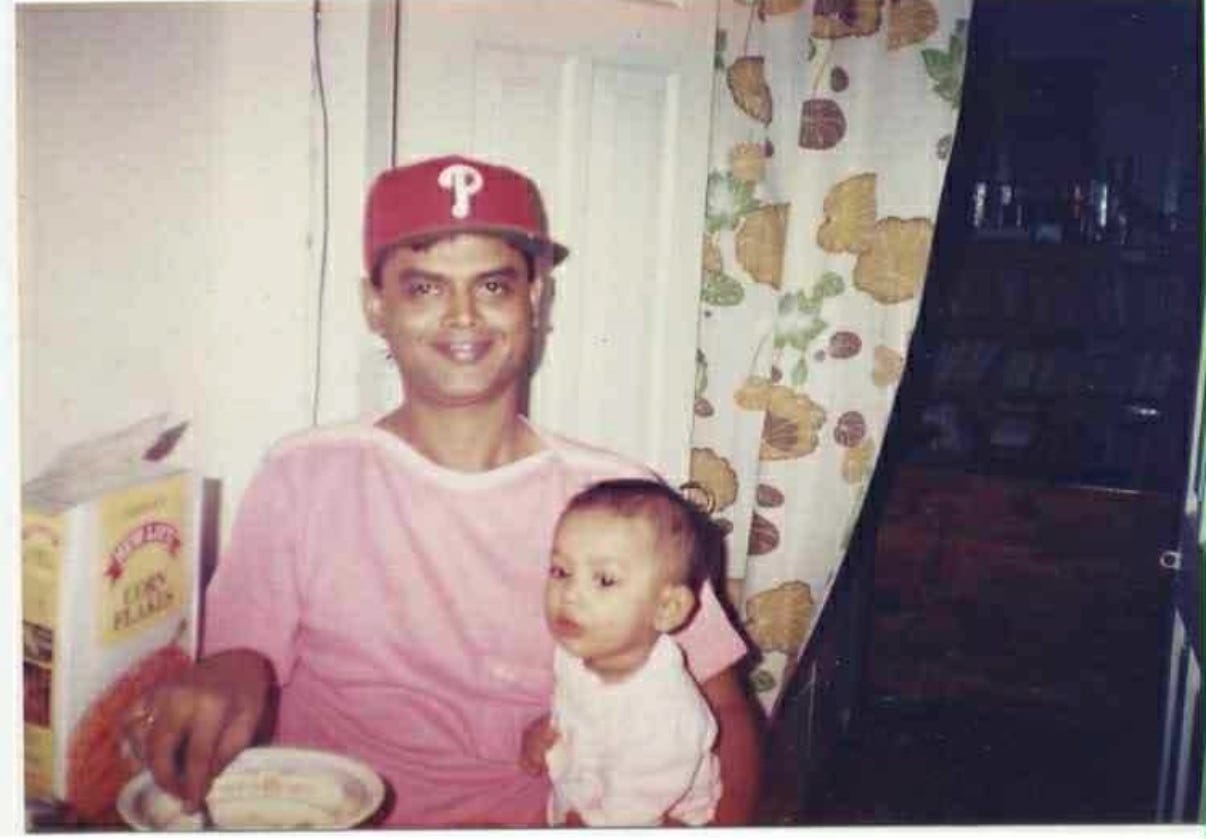
I love you more than words can hold, Abbu. I don’t know how to go on living and breathing in a world you’re not in anymore. You were my heart and my soul — the love of my life.
Rest in peace. I know you’re already making everyone up there in heaven smile and laugh the way you did here on Earth.
I will miss you and carry you in my heart every single day. And I will find the courage to go on, and face everything, come what may — even this — by looking it in the eye. Because that’s what you taught me to do.
Until we meet again, my father.
Your daughter.
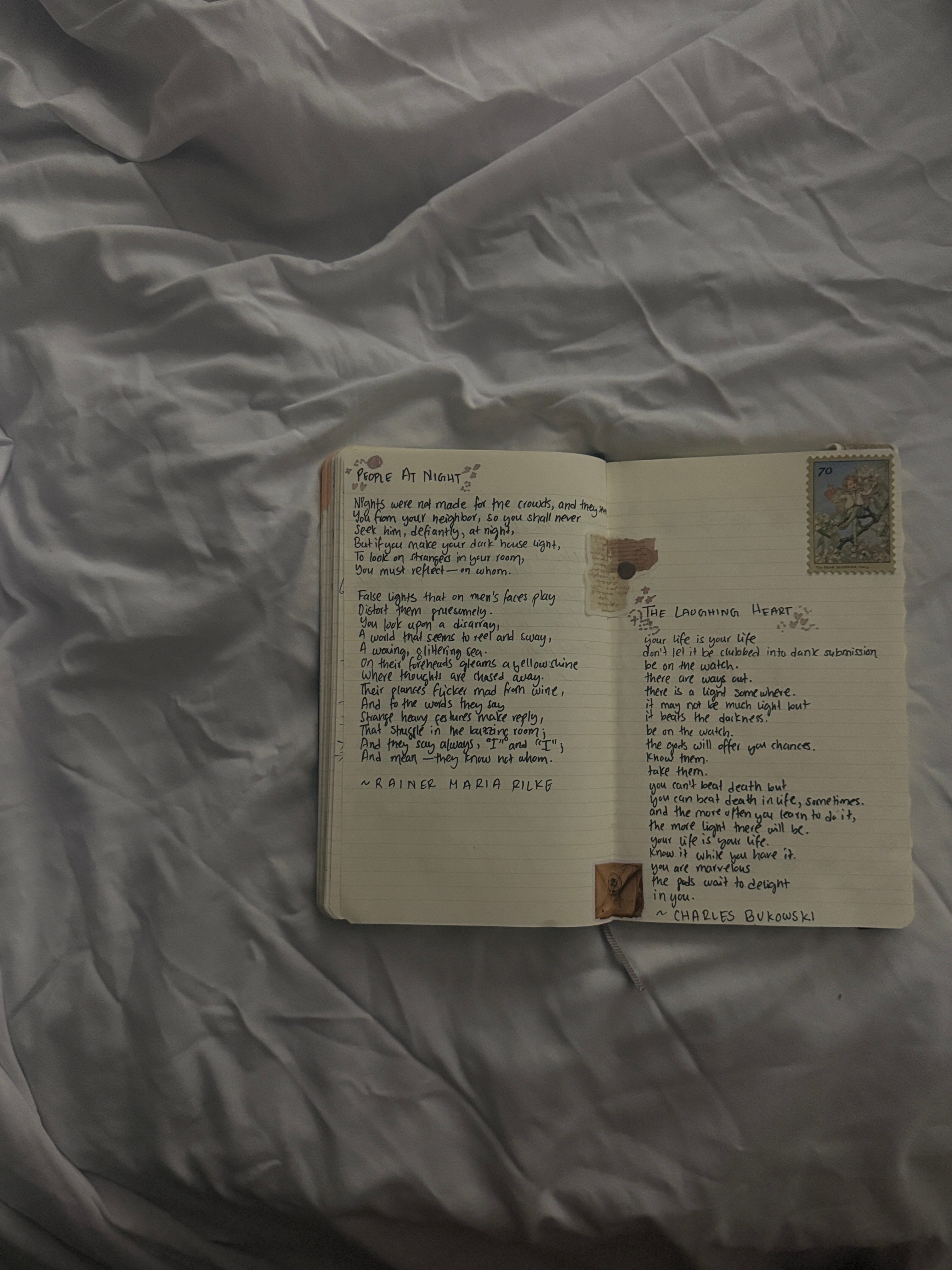
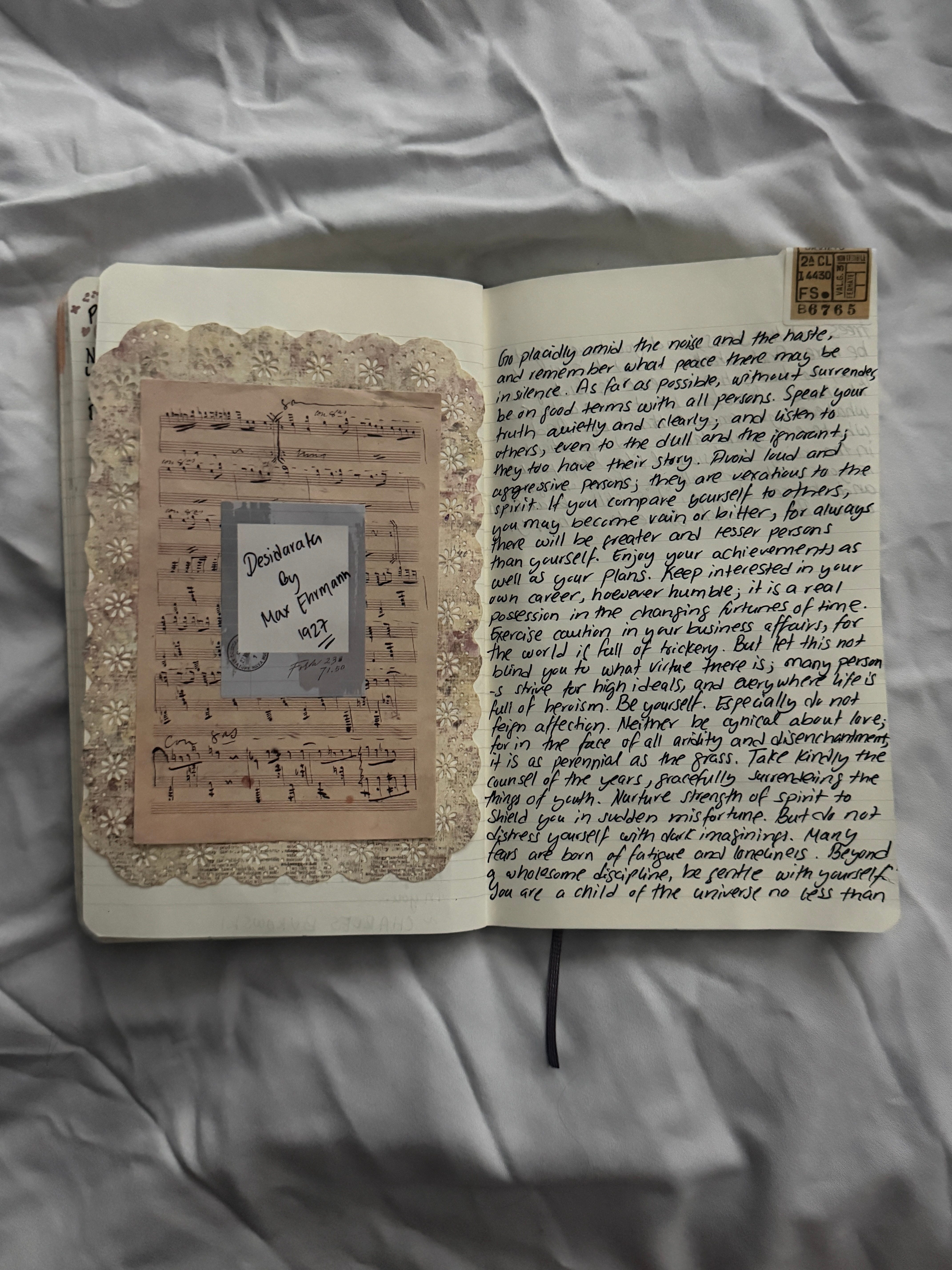
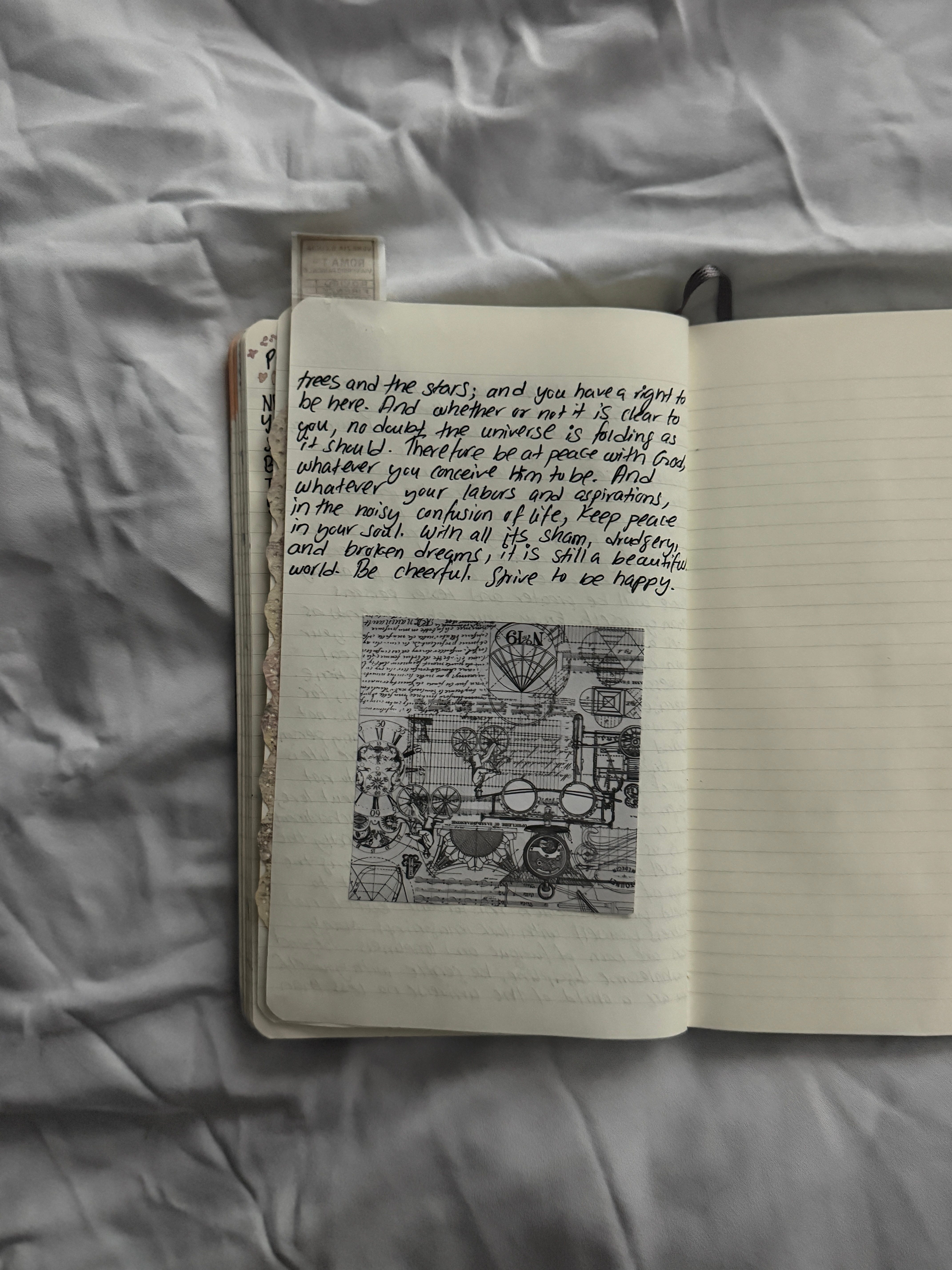
postscript
If you ask those who knew him, they will tell you without blinking — and mean it in the way one means things that are both believed and wanted — that this man was in Heaven. Please keep him in your prayers for a restful afterlife.
My father would want me to keep doing my work — so here I am, at my desk, doing it.
a postlude to family & friends
Thank you to all who sent prayers, words, tokens, gifts, and so much love over the past weeks, for keeping Abbu in your prayers. I’m blessed to have my family by my side — my wonderful, kind, supportive, caring, loving family. As well as friends, who are nothing short of. Without you, I would have been lost. Ammu, I love you. Thank you for giving me Abbu.
I leave you all with his favorite song.
A beautiful homage to love. I hope you find comfort in whatever you choose to believe. But, in terms of science explaining the human condition, remember science seems to always play a “catch up game”! Think of all the discoveries that dismissed previous strongly held opinions. Think of the fact that our physical senses only measure a minute part of the universe that we live in( sounds that the human ear can’t detect; sight hampered in darkness but not in the animal kingdom; pigeons finding their way home etc!). Don’t look to science to answer your questions. Listen to your heart and to the love that it holds.
Tear-jerking
I hope his soul rests in peace