


Featured this week: an exploration of why every generation remakes Shakespeare in its own image; a loving ode to bibliomania; a beautiful defense of handwriting as the last unmined territory of the private mind; a feel-good piece on American hope; an essay on nostalgia through a vintage light box; a photographic elegy for the disappearing newsroom; a librarian’s validation for those who choose audiobooks; a guide through Dante’s enduring relevance; a doctor’s take on the modern anti-vax movement; a poet’s close reading of Elizabeth Bishop; and a sweeping conversation with Senator Cory Booker on patriotism.
These essays range from The New York Times to Lit Hub to The New Yorker.
A note about The Weekly Reading Guide series: This will be November’s last guide. We’ll continue the series onto December to share a curated selection of the best essays, op-eds, and articles from great — and often overlooked — corners of the internet and media. For readers who don’t have time to scour online newsstands, are tired of the same circulating stories, and want thoughtful engagement with current cultural, social, political, literary, and artistic conversations.
Introducing: This Week’s Classic Essays: A few classical essays from the archive — to mix up current reads with foundational texts.
Read previous week’s guide:


More from the slow philosophy
Monthly Postcards: Books, films, poetry, short reflections.
Read the previous postcard below:

[Nov 24 - Nov 30, 2025]
Last Week’s Best Pieces of Writing
My guides span every corner of thought — newspapers, Catholic magazines, left-wing journals, faith, politics, pop culture, literature, arts. Each brings its own light. The aim is to read widely, think critically, and notice where ideas meet and where they part. No school of thought should be a fan club. Accountability, nuance, and the ability to take compassionate, principled stances are the only grown-up postures in life, society, and culture. Let’s think for ourselves and find common ground.
Every Generation Gets the Shakespeare It Deserves — The New York Times
The writer — a literary associate at the Shakespeare Theatre Company, which publishes the editions of Shakespeare I own — offers a sharp, funny look at why we keep reinventing Shakespeare to look like… well, us. Using the new Chloé Zhao film Hamnet as his backdrop, of course, he notes that Paul Mescal plays Shakespeare as a brooding heartthrob, and how a millennial cinephile posted a Letterboxd review proclaiming, “Not to be hyperbolic but this movie contains the actual meaning of life.” In contrast, he responds that the film “played to me like mumblecore Shakespeare, conceived for the TikTok generation.” His writes that every era fashions its own Bard and these portraits reveal more about us than about Shakespeare himself. We chase biographical clues in hopes of explaining why we feel the way we do about these plays, but we can’t really solve them by trying to unlock Shakespeare anymore than anyone ever has. We can delve into the life of the mysterious man but the mystery of his plays might be everlasting.
Writer: Drew Lichtenberg
Nothing Better Than a Whole Lot of Books: In Praise of Bibliomania — Lit Hub
This is a book-lover’s delight: an ode to the beautiful madness of collecting more books than you could ever read. Moving from Umberto Eco’s seventy-cent copy of Aristotle’s Poetics to the idea of “paper bodies,” the writer explores why so many of us crave the physical presence of books as much as the ideas inside them. He argues that owning books isn’t mere consumerism but a way of mapping who we are and what we still hope to learn. As a book collector since age seven, I agree. I have stopped trying to figure out where my passion for the physical copy comes from and I don’t think any one theory can truly put the matter to rest as they all seem to fit me just fine. Perfect for anyone who has stacks on the nightstand and double-shelved bookcases, which, I honestly think must be most of my subscribers.
Writer: Ed Sim
Paper-and-Pen Diaries Are Forever — The New York Times
This is a diary-lover’s delight, and Anais Nin, who kept a diary until she died, would adore it. A beautiful defense of handwriting in an era where everything feels scraped and swallowed by the digital. I love the humble diary — ink on paper, loose pages, half-formed thoughts. And it might be one of the last places where the human voice can exist untouched by algorithms. She talks about found diaries, Virginia Woolf’s loose-knit entries, and the way analog objects hold meaning that cloud storage never can. I love her message and her attempt at rescuing the human thought, and I’d like to join her. AI is stealing our words and thoughts, and jumbling them up for people to use as theirs, and as a writer, that’s really hard to cope with. But I’m so happy she reminded us that the safest place for our mind is still a notebook, and the act of writing is our freedom. I urge you all, alongside Ms. Koppel, to start keeping a diary.
Writer: Lily Koppel
Do Audiobooks Count as Reading? — The New York Times
Ever feel guilty for listening to the audiobook, rather than reading the actual text? Me too. But, as it turns out, our guilt may be unfounded. In this op-ed, Brian Bannon, the chief librarian of the New York Public Library, reframes the idea of listening to an audiobook as another — not a lesser — way of reading. He makes his argument for the merits of auditory reading from a perspective of accessibility, psychology, and a literary re-advent. More studies are showing how our brains are equally stimulated when intaking words through hearing as they would be through sight — so long as we are actively listening. At a time when American adults are reading for pleasure less and less, we can embrace the rise of audiobooks as a new method for accessing literature, not its intellectual inferior. So pop your AirPods in, kick your feet up, and enjoy a guilt-free listen to The Hunger Games. Brian says so.
Writer: Brian Bannon
Where Dante Guides Us — The New Yorker
This piece explores why The Divine Comedy still feels alive in the bones of modern society. The impact of this 700-year-old poem is startlingly contemporary: we can see that in the Primo Levi in Auschwitz and in the remixing of Dante with Led Zeppelin. The writer follows Dante through Hell, Purgatory, and Paradise, lingering on his doubts, his audacity, his politics, and his heartbreak for Virgil. She makes a compelling case that the endurance of Dante is a tribute to how human he is: ambitious, confused, stubborn, moved by beauty, always questioning. Doesn’t he sound like a man whose pathos would match the likes of today? I loved reading why this medieval epic continues to be read, and why it continues to feel like prophecy.
Writer: Claudia Roth Pierpont
Jorie Graham on Elizabeth Bishop’s “At The Fishhouses” — The New Yorker
The author, Pulitzer-Prize winning poet Jorie Graham, does a close reading of Elizabeth Bishop’s iconic poem, At the Fishhouses. I think more pieces like these should exist — I would love for a modern-day poet to close-read William Blake and Emily Dickinson for me. In revisiting it, Graham notes how through meticulous description — the gleam of fish scales, the sting of cold water — Bishop leads the reader toward a moment of near-spiritual insight, her genius for turning physical detail into metaphysical revelation, and why this poem still remains relevant.
Writer: Jorie Graham
Cool Enchantment — Public Books
Have you ever seen a vintage Hamm’s beer “Scene-O-Rama” light box hanging in an aging Southern California pizzeria? The writer has, and he explores why old advertising can feel strangely moving to us all. As someone who lives deep in nostalgia, this piece felt like a hug—it shows how even trivial objects can become portals into memory, fantasy, or the inner world if we let them. Next time you see an old but familiar ad, ask yourself why you feel the way you do.
Writer: M. P. Kennedy
The Offices Only a Newsperson Could Love — The New Yorker
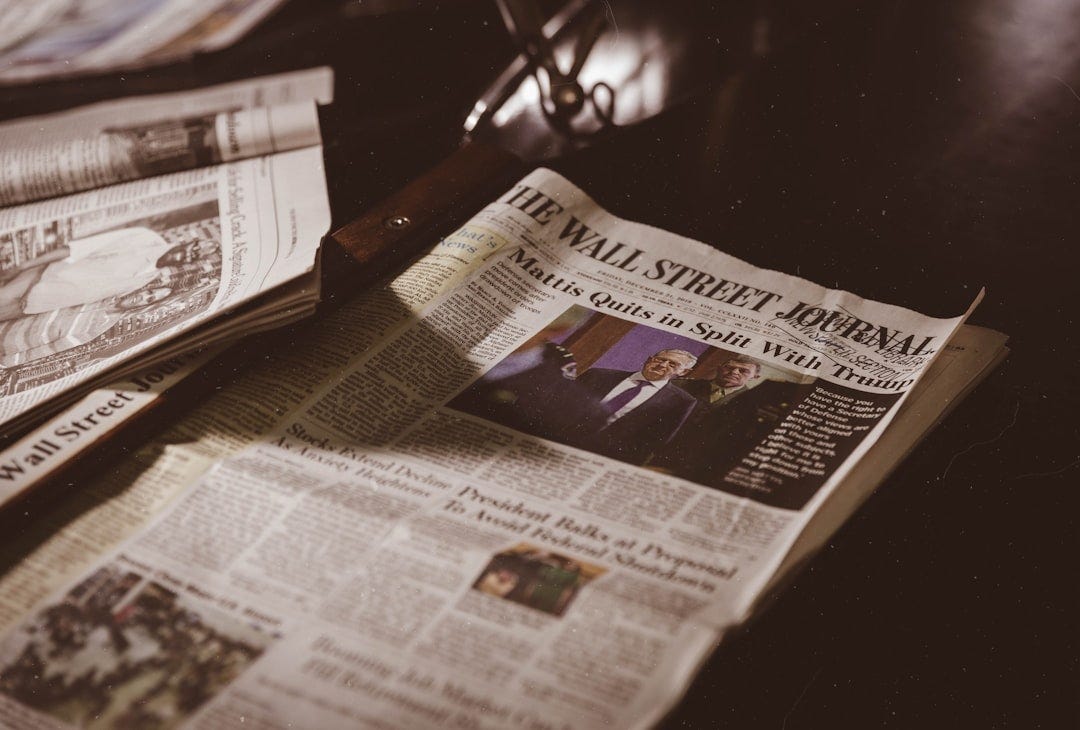
I had to include this piece as I’ve spent all of last month watching first amendment movies, and also, I love the first line: “There is something inspiring about an ugly building.” It’s so true. The idea of simple provisional, functional place feels so beautiful. This is a tender, funny, and slightly heartbreaking portrait of America’s shrinking local newsrooms from a writer paying tribute to Anne Hermes, a photographer who spent six years documenting American newsrooms. Included in the piece are photographs she took, throughout the years. I loved seeing the beauty and absurdity of these rooms: it’s unglamorous, respectable, old-school, beautiful journalism that survives because it’s necessary, and is held together by a stubborn sense of duty and clutch of the first amendment that all reporters share in their hearts.
Writer: Zach Helfand
Critical Thinking
Where does the writer’s worldview subtly reveal itself—in examples, doubts, or omissions?
I love the inclusions of the critical reflections with the material - thank you for sharing!
This curation is exactly what's missing from most feeds—nuanced, well-rounded reading instead of the same headlines circulating endlessly.
The range here (Shakespeare reinvention, bibliomania, paper diaries as last unmined territory of private mind, audiobooks validated, Dante's enduring relevance) shows intentional breadth. Not algorithmic suggestions. Human curation.
Your note about fighting for media literacy ("normalize content that protects us from brain rot, depleting critical thinking skills, fading practice of deep reading") is the real mission. AI scraping our words and jumbling them for others to use? Paper notebooks becoming the last safe place for human thought? That's not just nostalgia. That's preservation.
The critical thinking prompts (before, during, after reading) turn passive consumption into active engagement. That's the antidote to scroll culture.
Looking forward to December's shift (older essays, iconic works, annotations on lines worth rereading). This is essential work 💙