


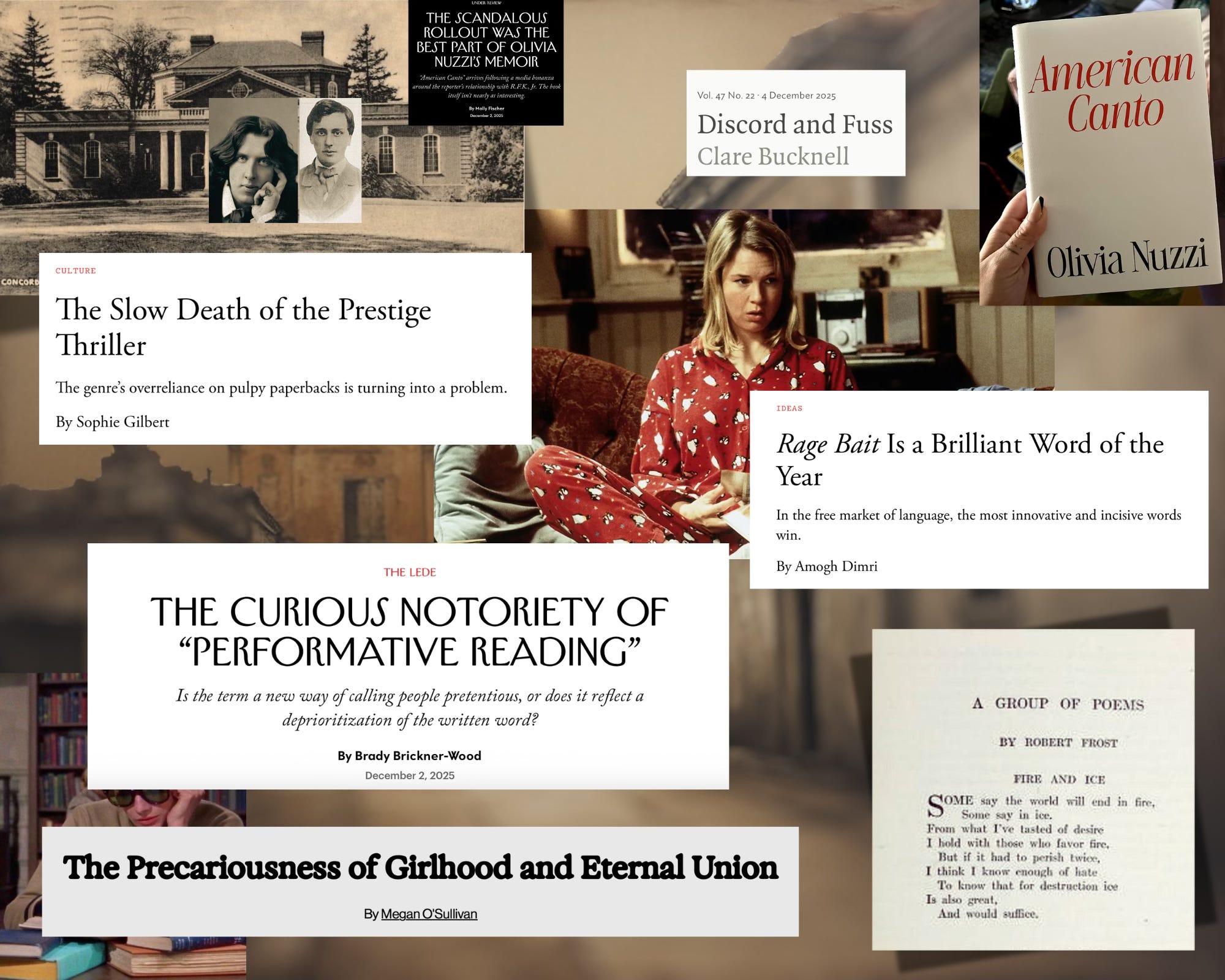
Featured this week: The best thing I read last week was The New Yorker’s lament on performative reading. Also included: an interview with author Helen Fielding in The Paris Review, a scandal in journalism, a personal account of girlhood & opting out of marriage from a coveted journalist, about a centuries-old library in Concord, the many tempers of Robert Frost, the controversy of “rage bait” as Oxford’s word of the year, and the fall of the prestige thriller.
This week’s essays are from The Paris Review, Lit Hub, The New Yorker, The Atlantic, and Byline — a mix of free and paywalled pieces.
Introducing — This Week’s Classic Essays: As part of The Weekly Reading Guide, I’m adding a new section featuring two essays from the canon, paired with guiding questions for deep reading. I’m experimenting with the format, so it may evolve — but the goal is to mix up current reads with foundational texts.
Featured this week: Essays by Oscar Wilde and Henry James.
These guides will remain nonfiction.
About The Weekly Reading Guide series: Includes the best pieces of writing — essays, op-eds, and articles — from great and rare corners of the internet and media that are often overlooked. If you don’t have time to scour online newsstands, are tired of the same circulating stories, and want to stay up-to-date on current cultural, social, political, literary, and artistic conversations and discourses, I hope you find this series useful.
Read previous guides:


About the Monthly Postcards: Books, films, reflections.
Read my latest below:

[Dec 1 - Dec 7, 2025]
This Week’s Classic Essays
Note: This week features two essays in vibrant contrast with one another — Wilde’s defense of life imitating art and James’s of art interpreting life. Those who are writers should find these to be compelling comparisons. Allowing ideas to unfurl over days rather than minutes would be more rewarding. They are dense.
The Decay of Lying - Oscar Wilde
In this dialogue, Wilde challenges the prevailing belief that art should imitate life. He argues instead that life imitates art, and that realism diminishes the imaginative power of culture. Through satire, he critiques the demand for factual accuracy in art and defends illusion as a necessary condition of artistic creation. He positions art as a force that shapes how the world is perceived.
The Art of Fiction - Henry James
James examines the novel as a serious artistic and intellectual form rather than a set of fixed conventions. He rejects rigid rules about plot, subject matter, and moral purpose, arguing that fiction should remain open to the full range of human experience. He believes what determines the quality of a novel is the depth and precision of the writer’s observation. The essay establishes perception and consciousness as the central criteria of literary value.
Critical Thinkin
Wilde vs. James — art, realism, purpose
Wilde treats illusion as the highest function of art, while James treats careful perception as its core discipline. Which view feels more convincing to you as a reader—and why?
If Wilde resists realism and James refines it, are they ultimately working against each other, or shaping two complementary definitions of artistic truth?
This Past Week’s Best Short-Form Writing
Note: My guides span every corner of thought. Each brings its own light. The aim is to read widely, think critically, and notice where ideas meet and where they part. No school of thought should be a fan club. Accountability, nuance, and the ability to take compassionate, principled stances are the only grown-up postures in life, society, and culture. Let’s think for ourselves and find common ground.
Catching Up With Helen Fielding - The Paris Review
A delightful interview with the creator of Bridget Jones’s Diary. Fielding speaks about her writing habits, the legacy of Bridget Jones, her deep influence from Pride and Prejudice, and how she gathers material through sharp social observation. I love hearing artists explain the strange mechanics of the creative life. She’s hilarious, self-aware, a little chaotic, and wonderfully honest about the mystery of where ideas come from.
The Curious Notoriety of Performative Reading - The New Yorker
Americans now read for pleasure 40 percent less than they did twenty years ago. Forty percent of fourth graders can’t comprehend basic text. Humanities professors are stunned by students who can’t complete readings or write analytical essays. Last week I shared a philosophy professor’s NYT op-ed warning that students have become “subcognitive” — a word that sounded ripped from 1984. Even the people who do read are increasingly doing it performatively. The author avoids sneering at readers and instead indicts the culture that produces this pressure. Beautifully written, full of passionate despair for the literary world. Brady Brickner-Wood
The Scandalous Rollout Was The Best Part of Olivia Nuzzi’s Memoir - The New Yorker
I’m putting this on here for the trifecta of human follies: salaciousness, melodrama, and breached ethics. Nuzzi, while covering RFK Jr.’s campaign, entered what an alleged affair of the mind with the politician. Her ex-husband detonated a Substack exposé alleging past improprieties — and also, RFK Jr.’s wife writes a memoir. Journalists perhaps shouldn’t be fraternizing — intellectually or carnally — with their married subjects. Women of the world: for the love of God, married men are not your romantic genre. On top of being a liability, it is a breach of girl code. Please choose someone from the uncoupled population — there are 100m singles roaming Earth as we speak.
The Precariousness of Girlhood and Eternal Union - Byline
A moving essay by Megan O’Sullivan, who poetically recalls calling off her engagement as a young woman after finally acknowledging her long-ignored cold feet. Marriage originated as a practical alliance system simply concerned with property, heirs, and stability. Romantic love wasn’t a thing until much later. I want to marry because of the mythology of courtly love that was passed down to me through the collective female imagination. Today, increasingly independent, women may simply opt out rather than shoulder the possible labor of managing unresolved and inherited emotional debris and covert misogyny. I don’t blame them. Why would they? While 18 is too young to avoid the danger of being psychologically groomed, even 25 without a grounded sense of self can feel unsteady. I cheered for her agency and unfathomable courage. Megan O'Sullivan
On the Infinite Lives of the Library - Lit Hub
Library lovers will adore this. The writer, a writer-in-residence at the 300-year-old library in Corcord, Massachusetts, shares stories of the building, its treasures, and its ghosts. Peace must be intoxicating for this man because it positively exudes in his words. The library houses handwritten manuscripts of Thoreau and draft chapters of Little Women. I also admire him for paying tribute to an unsung hero named Sophia — Thoreau’s sister. Without her editing his massive journals into publishable work, the canonical Thoreau as we know him wouldn’t exist. As the writer points out, by extension, imagine the impact: the environmental movement, Gandhi, MLK. All drew from him. He also shares how Ken Burns recently wandered through in advance of his American Revolution documentary. The whole piece is just… happy. A man deeply content in his ancient library. Why I have not begged someone to make me a librarian yet is beyond me, but I won’t get into that. Steve Edwards
Discord and Fuss - London Review of Books
Robert Frost, patron saint of my interior life, turns out to have been delightfully irascible! He refused to keep up with contemporary gossip, ignored reviews, and claimed not to know Ezra Pound despite being in the same contemporary circles. People associate Frost with solitude and snowy evenings, but the writer says that he would have laughed if we called him a literary figure. He did have friends but few and far between, and from what it looks like: chosen ones. He had a deep friendship with Edward Thomas, liked Wallace Stevens, and never got around to liking Pound or T. S. Eliot, thinking they were destroying poetry. He detested free verse, calling it “discord and fuss.” The Waste Land? Rubbish, in his view. He could be unreliable, but he was opinionated and emotionally candid, which is a combination I find endearing or maybe I just want to keep loving him but imperfect men with clear feelings is a rare combo. The writer is an Oxford fellow, who writes thoroughly about a poet we all love but know very little about.
Rage Bait Is a Brilliant Word of the Year - The Atlantic
Oxford has crowned “rage bait” as Word of the Year, succeeding “rizz” from 2023 and “brain rot” from 2024. Predictably, cultural conservatives lament this — calling it linguistic decline and claiming we’ve traded Shakespearean elegance for TikTok neologisms. Well, at least, they didn’t crown “67” as its word — but that’s probably because Dictionary.com beat them to it. Language will evolve — that’s what it does. The author predicts 67 will die — the way “on fleek” and “yeet” died as they were hitched to memes. But “selfie,” “cancel,” and “ghosting,” he predicts, will last — and so will “rage bait.”
The Slow Death of the Prestige Thriller - The Atlantic
I remember when Big Little Lies, The Undoing, Mare of Easttown, Sharp Objects, and Little Fires Everywhere were all the rage but yes, since then, I believe the prestige thriller has died. Hopefully, I predict, it’ll get, if it hasn’t yet, replaced by cozy murder mysteries like Knives Out, Agatha Christie, and The Thursday Murder Club — because I feel like people don’t want to panic right now but they’d want to solve a puzzle by the fireplace. This piece is about All Her Fault, a prestige thriller that, paradigmatically, I had not heard about.
Critical Thinking
Which insight, discomfort, or line of thought from this week’s pieces lingers — and what small shift in my thinking or behavior does it ask for?
I keep saving your reading recommendations until I finally have more time to check out all those articles.
Thank you for curating such intellectually driven lists for us, people who have to make a challenging choice between essays and classics to read an hour before bed :)
these weekly reading guides are incredibly well put together. i can tell you practice what you preach; slow deep reading! i love the classic essays, i'm trying to educate myself on more classics and will be coming back to these when i can. great job tulipe <3