


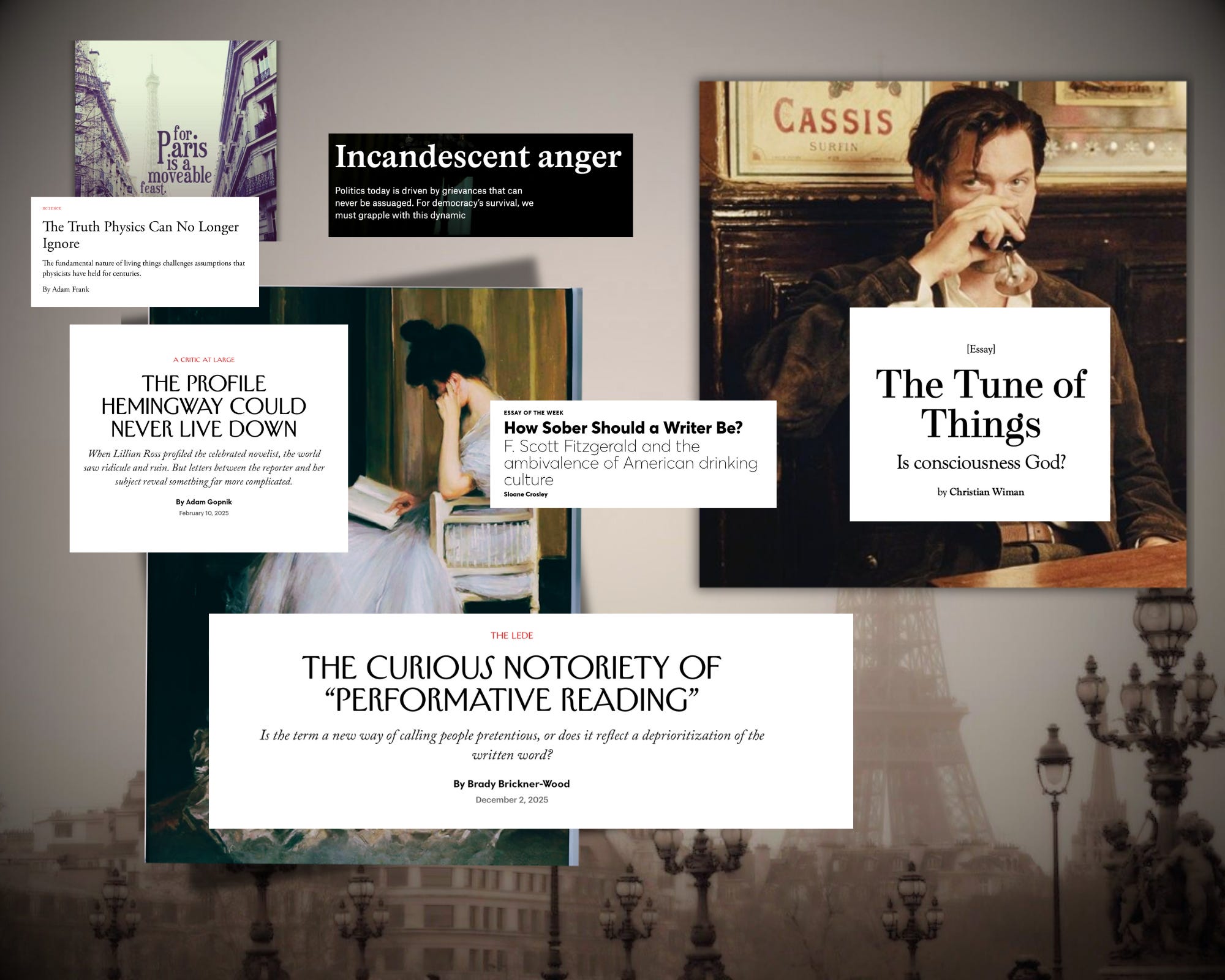
I spent hundreds of hours last year reading long essays across science, literature, philosophy, and history. These are the ones that stayed with me.
I’m thrilled to share my year of reading contemporary essays. The topics range across literature, psychology, sociology, and political theory; and from biology, physics, and climate science to questions of consciousness, ethics, and meaning. The weekly reading guides series began last fall, but the essays here are from the year as a whole, although several make a come back as they were simply too good and substantial to leave out of the year’s roundup.
I’m sometimes asked how these pieces are found — and the honest answer is I follow my tastes and interests and curiosities and sensibilities, wherever they may lead. I also have a hobby of spending hours browsing the newsstands — online as well as, when the mood strikes, the one across the street, where I can thumb through the pages and annotate favorite lines at home. Choosing what to keep and what to leave out is invariably difficult as there are endlessly fascinating essays being produced by top-drawer writers on a range of subjects. Ultimately, I keep the ones that resonate most deeply with me — those that, through their meticulousness of thought and great writing, show me something new and unfamiliar or add to and amplify my existing notions.
You’ll always find a great deal of literary pieces in my guides — on the criticism and study of literature, including the history of authors, their intellectual lineages, and influential books. Alongside, you’ll find essays on political and sociopolitical theory, as well as work from the sciences. Although my background is in public policy, I’ve been a science student as early as education began so I gravitate towards essays that grapple seriously with scientific inquiry. When it comes down to it, I’m most drawn to intelligent and compassionate writing, particularly when it explores narrow fields in ways that uplift thinking.
I’ve left out the usual reflection questions this time. But I invite you to read what draws you in after the blurb and ask how it might press upon your own life and preexisting notions. They’re not all meant to be read — it’s entirely worthwhile to commit to a single publication or even a single long essay and understand its points of view in sustained contrast with your own. Those are the ways critical thinking is built and taste is refined.
Without further ado — happy 2026, and happy reading.
Featured this week:
Performative literacy; making imaginary and lost books physical; Hemingway’s misunderstood reputation and vulnerability; the flawed ideology of the modern work life; biology vs. physics; how our emotions differ across our ancestors; Toni Morrison’s influence on publishing; Malcolm Cowley and the making of American literature; a history of the global order; America’s strength despite domestic dysfunction; viruses and the human evolution; understanding solar storms; why it’s okay to feel negatively about art; alcohol and authors; if public anger is a political identity; if the universe is evil; the biological science of ultra-slow intraterrestrial life forms in deep time; the decline of reading culture; the metaphysical meaning of consciousness; why we shouldn’t fuss with deep time; Carl Jung on what kind of company he liked to keep; Eve Babitz’s Los Angeles journals; and an interview with French playwright Hélène Cixous.
Bonus:
5 favorites from America’s Best Essays 2025 (featuring essays published in 2024).
This week’s list spans:
The New Yorker, The Atlantic, Aeon, Foreign Affairs, Noema, The Yale Review, The Baffler, Harper’s, and The Paris Review — both free and paywalled.
More from the slow philosophy
I write essays and curated recommendations of the most nourishing, thoughtful, expansive, and enriching media that I find especially meaningful and worth sharing. Subscribe below to receive new work and reading guides.
About The Weekly Reading Guide series: A curated selection of the best essays, op-eds, and articles from great — and often overlooked — corners of the internet and media. For readers who don’t have time to scour newsstands, are tired of the same circulating stories, and want thoughtful engagement with contemporary literary, cultural, social, political, philosophical, psychological, scientific, and artistic conversations.
This Week’s Classic Essays: Each guide also includes a section featuring canonical essays from the classical archives — to mix up current reads with foundational texts from the history of great prose. Read the latest:

About the Monthly Postcards series: An ongoing archive of books, films, poetry, art, and music I’m personally consuming and recommending. Read the latest:

About the Quarterly Letters series: A thematic syllabus for deeper living, reading, and self-study. Read the latest:

About The Slow Philosophers Book Club: An intimate circle that discusses one short classic over a month. Sessions announced as they arise. Limited space. Request to join here.
(follow ig: teacupletter)


[Jan 1 - Dec 31, 2025]
The Best Essays I Read in 2025
A year of reading across disciplines, curated and offered in the spirit of shared inquiry.
Note: My guides span every corner of thought. Each brings its own light. The aim is to read widely, think critically, and notice where ideas meet and where they part. No school of thought should be a fan club. Accountability, nuance, and the ability to take compassionate, principled stances are the only grown-up postures in life, society, and culture. Let’s think for ourselves and find common ground.
The New Yorker
The Curious Notoriety of Performative Reading
Americans now read for pleasure 40 percent less than they did twenty years ago. Forty percent of fourth graders can’t comprehend basic text. Humanities professors are stunned by students who can’t complete readings or write analytical essays. In fact, the receding nature of reading has gotten so bad a philosophy professor’s NYT op-ed, which I shared last year, warned that students have become “subcognitive” — a word that sounds ripped from 1984. Even among those who still read, the practice itself is now viewed with suspicion. It is important to understand this — and why it’s happening. This essay does this by discussing the phrase “performative reading,” which has emerged to describe people —often men — who read difficult or canonical books in public, allegedly to project intellectual seriousness. Rather than treating this as a matter of individual pretense, Brickner-Wood argues that such suspicion might fit into a broader cultural pattern that we might need to understand better if we’re going to do something about the declining culture of reading. Why does anyone do performative reading at all? Nearly everything can now be dismissed as performative: activism, masculinity, kindness, and even grief. The current times make authenticity tricky. Against this backdrop, maybe “performative reading” isn’t about insincere readers at all but rather how reading itself has been pushed to the margins of culture. Today, we can easily access music, art, and video, but the experience of reading a long, complex book requires time, patience, solitude, and attention, capacities increasingly at odds with contemporary life. Seen this way, the sight of someone quietly reading in public today might feel alien because it is so rare to those struggling with sustained attention. But the public reader may not be performing at all. Maybe they’re doing something harder instead — maybe they are sitting with boredom, discomfort, and silence — to think more clearly and understand themselves better.
The Best Fake Books—Made Real
Reid Byers is a former I.B.M. systems designer who has spent fifteen years creating and collecting physical versions of books that don’t exist. They’re books that are lost, unfinished, fictional, or embedded within other works. He even designs them to look like aged volumes. This fascinates me for I am a forager of hidden gems and he a creator. He has brought to life things like Hemingway’s lost first novel, Aristotle’s vanished Poetics on comedy, Shakespeare’s play-within-Hamlet, and doubly fictional works from Lolita, all crafted to fool rare books experts at a glance. Byers sees these unreal books as a tribute to literature’s absences — projects destroyed by ego or politics, interrupted by chance, or never written at all. Just this week, I was reading Eros The Bittersweet from Anne Carson, which made me look up some poems by Sappho. The fact that this mesmerizing poet’s works are lost to history breaks my heart. Like me, the imaginary book Reid Byers too most wishes were real is Sappho’s, because “some things just break your heart because they aren’t real.” A man after my own heart.
The Profile Hemingway Could Never Live Down
Lillian Ross was a longtime New Yorker writer best known for pioneering a restrained and observational style of journalism where rather than explaining or judging her subjects, she carefully recorded what they said and did, for long stretches, and let scenes speak for themselves. She did a profile for Hemingway in the 1950s that had long been treated as a brutal takedown of the author. But the essay reexamines it and argues that neither was it meant to humiliate Hemingway nor did it do such a thing. Her new and detached reporting style may have been confusing for people but letters between them show a complicated, mutually respectful relationship. Hemingway admired her even as the profile portrayed him as boastful, performative, and deeply insecure. In reality, Hemingway was oddly cooperative and the profile succeeded because it captured his real vulnerability more clearly than his own later fiction. Always fascinating to learn a bit more about the riot that was Hemingway.
The Insidious Charms of the Entrepreneurial Work Ethic
A great companion read to my viral essay, “In Praise Of Gazing At The Ceiling, And Other Trifles,” this essay examines how the modern ‘entrepreneurial work ethic,’ the idea that work should be personally meaningful, passion-driven, and endlessly self-directed, has become a powerful but exhausting ideology in American life. The writer argues that this ethic reframes insecurity, precarity, and overwork as personal and individual challenges rather than structural problems. Popularized by management thinkers, Silicon Valley culture, and platforms like LinkedIn, this encourages workers to treat themselves as brands and businesses, promising freedom and purpose. The writer argues that it fails to achieve such odds and instead mostly succeeds in shifting risk onto individuals, weakening collective protections, and normalizing constant hustle. We don’t see the transactional reality in which workers are isolated, disposable, and left laying their own tracks with no clear destination. As someone who’s worked corporate for nearly a decade, I can attest to this rudderlessness. Bertrand Russell called this the result of an elite class convincing a working class of the concept of “dignified hard work,” preserving leisure solely for those in the upper crust.
The Atlantic
The Truth Physics Can No Longer Ignore
Physics is undergoing a bit of an identity crisis. For much of its history, physicists believed the universe could be fully understood by decomposing it into its smaller constituents: atoms, particles, forces, This idea is called reductionism. It proved successful for describing the likes of inert matter, planets, stars, and machines. But life doesn’t fit that model very well. Living systems are not fixed objects in the way rocks or machines are. The human body, for example, replaces most of its constituent atoms over time. We’re not fixed objects. A cell makes the membrane that keeps it alive, yet that same membrane is what enables the cell to remain viable. No conventional machine exhibits this kind of self-referential organization. Physicists are great at prediction within closed systems. Give them a star: they can predict how it will die. Give them a rock: they know exactly what it’ll do. But give them a single primordial cell, no amount of physical law would allow them to predict that, billions of years later, it would give rise to humans… or pandas. That’s because life shows emergence: the phenomenon by which interactions among simple components generate novel, irreducible, and often unpredictable forms of organization. Life does something nothing else in the universe does. It uses information in the service of its own goals. Plants grow toward light. Animals evade danger. Machines only do these things because living agents programmed them to do so. Living systems, on the other hand, generates its own ends. Scientists call this agency. Physicists aren’t abandoning math or particle but they are realizing that not everything important is at the microscopic level. They’re turning to complexity science, which studies systems where simple things together create surprising behavior — like ecosystems, brains, economies, and societies. Approaching life through this lens may illuminate longstanding questions about how life began, how to detect it on other planets, and how to think more clearly about intelligence. Studying life may reshape physics itself, pushing it toward a more collaborative, interdisciplinary future.
What If Our Ancestors Didn’t Feel Anything Like We Do?
As someone who tears up during movies that are supposed to be action comedies, I’ve come to realize what a privilege it is to feel so freely today. For much of human history, people seem to have repressed their emotions far more than we do now. Historians argue that people in the past didn’t experience emotions the same way we do — feelings like pain and anger were shaped by culture, religion, and daily life, not universal human constants. Instead of assuming we can easily relate to past emotions, the writer suggests studying the worlds that gave those feelings meaning, such as medieval pain tied to Christ’s suffering or Greek anger seen as cosmic disorder. What connects us across time may not be identical emotions, but more a sense of curiosity about how others experienced the world in the past and how they do it in the present. I believe that what triggers our emotions depends entirely on what we were taught. Some grow angry at frustration because they have never learned denial. Others cry when struck, while some answer injury with fury. The response is always relative. We mature out of most of our emotions eventually, and some take longer. Given the vast sweep of time, it makes sense that our collective emotions evolve alongside it.
How Toni Morrison Changed Publishing
It’s time to highlight Toni Morrison’s hugely influential but often overlooked career as a book editor at Random House, alongside her work as a novelist. Long before she became famous for her fiction, Morrison used her editorial power to publish, protect, and rigorously shape the work of Black writers, activists, and thinkers — among them Angela Davis, Huey P. Newton, Gayl Jones, and Leon Forrest — at a time when publishing was deeply resistant to Black voices. She believed Black writing didn’t need to define itself through whiteness or racism to be powerful, and she fought to bring complex books to both Black and general audiences. As an editor, she was exacting, fearless, and strategic, defending her authors against sexist and racist pressures while insisting on artistic integrity. The piece argues that Morrison reshaped American literary culture from being inside the belly of the beast — and that when she left Random House in 1983, the number of Black authors published there sharply declined, revealing how much of the progress depended on her vision and labor, which others weren't willing to do.
The Man Who Rescued Faulkner
Malcolm Cowley, not a famous name per se, is one of the most influential figures in shaping modern American literature. He did not write any great novels himself but as a critic and editor, launched and revived the careers of writers such as John Cheever, William Faulkner, Jack Kerouac, and Ken Kesey (One Flew Over the Cuckoo’s Nest), most famously rescuing Faulkner from obscurity (leading to his eventual Nobel). Coming of age after World War I, Cowley hung out with Gertrude Stein’s lost generation writers in Paris. He believed American literature deserved to stand on its own right rather than be seen as an offshoot of British writing, and devoted his career to building that case. Though his political judgments faltered at times, his lasting contribution was showing how American writers, deeply shaped by history, place, and national conflict, collectively formed a living literary tradition and claim its own “Great American Novel.” He later saw the elevation of Moby-Dick, which he considered even more important than Faulker and Hemingway.
Foreign Affairs
The Stagnant Order
The long historical era in which rising powers — countries with rapidly expanding populations, economies, and military capabilities — reshaped the global balance of power is coming to an end. Unlike the past two centuries, when industrialization, demographic growth, and territorial expansion led to the dramatic rise of powers (Britain, the U.S., and then China), today, most major countries are faced with steady demographic decline, sluggish productivity gains, and technological change — none of which radically transform daily life the way industrialization did back then. As a result, no nation is currently growing fast enough to overturn the established global order, creating a stagnant world of incumbent powers. This could reduce the long-term risk of power wars, but it also brings some dangers: fragile states can fuel instability and conflict. The era of rapid power transitions is ending, but its aftermath may be just full of peril. A thoroughly riveting piece on the history of global order.
The Strange Triumph of a Broken America
America’s global power remains remarkably strong even as its domestic politics and society appear deeply dysfunctional. Despite high levels of polarization, distrust in government, economic frustration, and political instability at home, the United States still leads the world economically and militarily in absolute terms, and no rival power has yet displaced it. Beckley calls this a paradox: the very features that make the U.S. powerful abroad — economy, demographics, institutions — also contribute to political conflict. He warns that if leaders fail to manage the tension between strength overseas and dysfunction at home, America’s relative advantages could eventually erode, weakening both foreign influence and domestic resilience.

Noema
Viruses Play a Leading Role in Humanity’s Story, and Not as a Villain
Viruses are not just enemies of humanity but crucial partners in our evolution. Over millions of years, viruses — especially retroviruses — have inserted their genes into our DNA, and many of those genes were repurposed for vital human functions. One viral gene made the placenta possible, others helped shape our immune system, brain function, memory, and early embryonic development. Nearly half of the human genome comes from ancient viral material. While viruses can cause disease, they have also driven innovation in genetics and aided survival, meaning humans quite literally would not exist without them. Rather than being purely villains, viruses are a foundational force in life itself. Although viruses are commonly associated with illness, pathogenicity represents only a small subset of viral diversity — and it’s worthwhile knowing that only a narrow slice of their interactions with life account for illnesses and the rest of it supports scientific insight into evolution and genetic exchange.
The Unseen Fury of Solar Storms
The Sun isn’t just a warm ball of light. Sometimes, it becomes violent. A solar storm happens when the Sun releases huge bursts of energy and charged particles into space. These usually come from sunspots, which are darker, cooler areas on the Sun caused by tangled magnetic fields. When the magnetic energy builds up out of hand, it snaps and explodes. This can create two dangerous things: solar flares (radiation at the speed of light). and coronal mass ejections (clouds of charged particles that move slowly but are far deadlier). Solar flares reach Earth in minutes but CMEs take hours and days — and they’re the real problem. For most of human history, this didn’t matter at all as we didn’t use electricity or GPS or satellites but today, everything we rely on depends on electricity and satellites. As a result, the Sun has become a serious threat to us. In places like the UK Met Office’s Space Weather Center, scientists watch the Sun 2/7 using satellites. Most solar storms are harmless but scientists worry about the big ones, which can effectively shut down parts of the world. A British astronomer named Carrington once recorded a powerful solar storm that burned telegraph wires as auroras lighted up the sky — messages were sent using the storm’s energy. Luckily for us, tech was simple back then. Today, it would create a global storm that could leave millions of people without electricity for months or years. The transformers we currently have are extremely hard to replace, and if they get overloaded by currents from CMEs, it can take years for them to be rebuilt. Satellites are especially vulnerable as they are outside Earth’s protective atmosphere — in fact, dozens of Starlink satellites were destroyed in recent storms. Bad news is that the Sun may be capable of storms twice as powerful as the Carrington Event, and far beyond what we’re prepared for. So if a big one happens: it would be chaos. Fragility, thy name is human life.

The Yale Review
Taking Offense
In Jane Austen’s Persuasion, the novel’s description of a mother, Mrs. Musgrove, grieving her dead son is strikingly cruel. Mrs. Musgrove is described as fat, and the narration suggests that her expressions of “tenderness and sentiment” are faintly ridiculous, implicitly inviting the reader to laugh at a grieving mother. The writer finds the passage cruel and disgusting. Reading it made him feel both hurt and offended. However, he accepts that reaction. He says that feeling offended by art is normal and valid. In moments like these, he suggests, we have the power to step back and ask what the text is doing to us. Either we can suspend the offense for a moment so we can still see if the work has anything important in it, or we can stay inside the bad feeling and examine it because sometimes the most meaning ideas emerge from these moments of discomfort. Literature after all can make us more empathetic and provide moral insight. The essay suggests that serious art often asks us to endure discomfort so we can discover new ways of seeing others — and ourselves — on the other side of that unease. Sometimes, art uses discomfort to show how prejudice works and how it might be undone. I like essays that expand upon the art of reading and what literature demands of us. That said, I also believe we have a responsibility to maintain high standards in art. There’s nothing wrong with sitting with discomfort and exploring it to learn something about ourselves. But if, say, art is being deliberately exploitative, and relying on shock as a substitute for depth, for instance, that’s where I draw the line. At that point, time is better spent engaging with work that is more deserving. There is no dearth of rich, challenging, and fascinating art. Writers who treat their audience as if they’re unintelligent, which is what exploitative feels like, don’t sit well with me. Emerald Fennell comes to mind, whose work often feels reducible to, “Here’s just a list of crazy things happening.” That to me feels like a form of being manipulated rather than being invited to understand. To that, I take offense.
How Sober Should a Writer Be?
Does alcohol help writers? The author of this essay offers no lurid drinking anecdotes of the sort readers often expect from writers. Instead, the piece interrogates the mythology itself. We have elevated the drunken writer much as we have romanticized the tortured artist. These are figures whose excess is retrospectively framed as a condition of genius. Hemingway, Fitzgerald, and Bukowski belong to a lineage of men who wrote with extraordinary clarity and force while drinking themselves toward ruin. But now, that era is receding. Americans are drinking less now. Even writers no longer lean into the old practice of literary intoxication in order to discover and justify their craziest ideas. Where drinking once appeared casually in literary life — we could see them woven into scenes of literature, leisure, and sociality — it is now either treated with gravity or omitted altogether. The author especially lingers on Fitzgerald, who wrote beautifully about drinking and glamour and excess, even though alcohol slowly dismantled his life. Even though we know drinking is harmful, we romanticize it when it’s tied to art and creativity. But did alcohol make Fitzgerald a great writer? Almost certainly not. What it did do, the essay suggests, was profoundly shape the texture and trajectory of his work, for better and for worse. In contemporary literature, the drunk and his wild nights are not charming or rakish anymore but rather volatile and dangerous. But still, we raise a glass to Fitzgerald, the eternal cautionary tale and patron saint of literary intoxication, who proved that some writers can handle the bottle, and some definitely cannot.

Aeon
Incandescent Anger
Much of today’s politics is driven not by clear goals or shared ideals, but by perpetual grievance, and constant anger and opposition. Unlike movements that mobilize outrage in pursuit of concrete social change, what the essay terms “grievance politics”treats hostility itself as the principal accomplishment. Even after leaders and by association, their followers, “win,” they remain angry, compelled to seek out new enemies. The essay contrasts this dynamic with older political movements, like protests against the Vietnam War or apartheid. Those movements were fueled by anger too — but their anger had a clear goal: ending a war or dismantling an unjust system. Once those goals were achieved, the anger largely faded. In contrast, today’s “grievance politics” seem to resist resolution. If one complaint is addressed, a new one appears. The persistence of anger itself is the point.. The essay argues that this is a matter of identity. Shared anger provides meaning, belonging, and self-worth. Shared grievance transforms pain and disappointment into moral righteousness, blame, and ultimately, group identity. For anger to survive, enemies must exist — as a result, avenues toward compromise or policy concession—any gesture that might mollify antagonism—are rare considered. To move forward, the author contends, society must recover shared values worthy of collective care: values like justice, community, and dignity. He does not dismiss the human desire for belonging. Rather, he believes that we can find purpose and solidarity, which need not be forced through perpetual conflict.
Reality is Evil
Many people are inclined to believe nature is balanced, healing, and always renewing itself. The author says that while that intuition is comforting — it’s hardly true. He points to thermodynamics, the physics of energy and heat, to argue that the Universe has an intrinsic directionality: over time, things move from order to disorder. That irreversible drift is called entropy. Things wear out, bodies age, stars burn out. Energy doesn’t disappear but changes form, but it spreads out and becomes less useful over time. Eventually, the Universe heads toward what the essay calls a “dark era’ where energy is so thoroughly dispersed that no new complex can arise. So even though life looks creative and growing (it’s flourishing plants, evolution, and technology), it’s still part of the same process: everything ultimately leads toward breakdown. Because all living systems survive by consuming other systems, and they, too, end in decay and death, the essay claims that the Universe is not morally good or neutral but actually, structurally hostile, perhaps even evil. If this is the case, what becomes of morality? He rejects ethical frameworks that exhort us to “live in harmony with nature” (which would mean cooperating with a destructive system) and suggests that we resist nature instead. Even if entropy cannot be defeated, it can be opposed. Care for others, alleviation of suffering and harm, and making medicine to prolong and improve life are such acts of defiance. Even if the Universe will ultimately prevails, he insists that we should “strike back” where possible, refusing complicity where we can, and build ethical and aesthetic values around solidarity and defiance in the face of inevitable decay.
Long Live the Aeonophiles!
Recent discoveries of so-called intraterrestrials — microbial life forms residing deep within Earth’s crust and beneath the seafloor — may compel a rethink of biology. The author refers to these extraordinarily long-lived organisms as aeonophiles, inhabitants of environments once assumed to be inhospitable to life. Though they remain metabolically active, their pace of change is so slow that they may not divide for thousands, hundreds of thousands, or even millions of years, expending their scant energy primarily on maintenance and repair rather than growth instead. Their life cycles largely elude us because they unfold on the scale of geological deep time. Just as a creature with a lifespan of a single day could scarcely comprehend the growth of a tree, we struggle to perceive biological processes operating at such extreme temporal distances. When periodic disruptions such as earthquakes and volcanoes occur, they may briefly rouse these organisms to grow and reproduce, after which they return to near-dormancy for vast stretches of time. Beyond Earth, aeonophiles dramatically expand our conception of habitability, suggesting life can survive in far harsher, quieter environments — including other planets — while remaining difficult to detect. At a deeper level, aeonophiles reveal that living systems can generate and manage entropy across timescales far longer than biology has traditionally acknowledged. They challenge the boundary we draw between life and non-life, as well as the assumption that life must be defined by growth and reproduction, showing instead that life can persist by managing energy and resisting decay over immense spans of time.

The Baffler
We Use to Read Things in This Country
Part lament, part satire, this essay mourns the shrinking attention span of the American public and the corporatization of reading culture. It rails against the algorithmic flattening of intellect, reminding readers that reading was once an act of resistance, not recreation. Its title feels like both an elegy and an accusation because that’s what this piece is — a lot of wonderful passages that embark on our intellectual history.
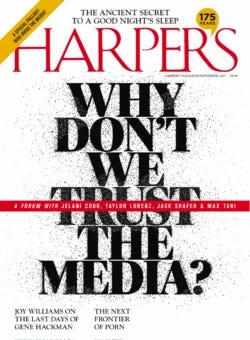
Harper’s
The Tune of Things
Is consciousness just something your brain produces… or is it something bigger, like a force in the universe — maybe even what people mean by God? Writing about neuroscience, quantum physics, mysticism, poetry, near-death experiences, and brain science, the writer argues that modern culture is trapped in a narrow, mechanical way of thinking that separates mind from matter and dismisses all sense of intuition, meaning, and mystery. He suggests that consciousness may exist between things — relational, flowing, and prior to material form — rather than locked inside individual brains. He doesn’t claim he can “prove” God. Instead he suggests a possibility: consciousness might not be confined inside individual brains. It might be something like a “field” that everything participates in (he connects this to quantum ideas about how things are linked). Poetry and music matter to him because they can make you feel that connectedness—like reality is alive, moving, and meaningful, not just mechanical. Art as well as religious experience can momentarily tune us into this deeper reality, even if such moments don’t last. If consciousness precedes matter, then death may not be an end but a return to a larger field of meaning, and our task is to learn how to live and love within that uncertainty.
The Geological Sublime
The author starts with an earthquake in Santa Monica that literally cracks his wall open. It scares him, but it also makes him feel awe, because it’s a reminder that the Earth is powerful and “inhuman”—it has been building mountains and shifting continents for millions to billions of years, long before humans existed. Then the essay shifts to something personal: the author loves watching butterflies. Butterflies have existed for tens of millions of years — but now they’re collapsing in just a few decades. That time mismatch is what climate change feels like: human actions are speeding things up way beyond what nature normally does. Climate crisis is hard to understand because humans think in short units — seasons, school years, elections, mortgages — while Earth works in long stretches of time: deep time. Darwin and the geologist Charles Lyell struggled with this too. They tried to explain how tiny changes add up over enormous time, but even they admitted deep time is almost impossible to truly imagine. Near the end, the author brings in the idea that messing with deep time is dangerous. Burning fossil fuels is like releasing millions of years of stored sunlight (from ancient plants) in just a couple centuries. That’s why the Earth now seems to “push back” with wildfires, floods, and heat waves. We can’t stop earthquakes, but we can choose not to make human history into a disaster by overheating the planet. We need to think on bigger timescales to understand what we’re doing.
Jung and the Restless - Carl Jung
While Freud focused on fixing human pathology from the past to change human psychology in the present, Jung’s psychology focused on understanding meaning and inner development across a lifetime. His ideas about the unconscious mind still influences how we understand personality, dreams, and meaning. We have him to thank for the concept of the “collective unconscious” — that all humans share deep, inherited patterns of thought. In this interview, we get to see Jung’s own psychology and personality more closely. He explains that he felt uneasy around writers whose lives were not deeply driven by a single, consuming purpose. He admired Goethe because Goethe had a central purpose. Faust was his central life task. But Jung felt repelled by figures like Thomas Mann, whom he saw as intellectually brilliant yet not existentially “gripped” by his work. He further describes a disturbing encounter with H. G. Wells, during which Jung felt psychically exhausted and even experienced a strange, symbolic vision of Wells shrinking, as if Wells were unconsciously feeding off him. All this to say, he tends to avoid people without a clear “principal task,” because being around them leaves him depleted rather than energized. Like they say: you are a product of what you surround yourself with.

The Paris Review
Journal, 1969–1970
Long before Joan Didion became the default literary lens on California, Eve Babitz was chronicling Los Angeles from the inside — capturing wit, perception, the sun, and style. This piece presents newly published excerpts from Eve Babitz’s only surviving diary, written in 1969–1970 when she was 26 and still becoming the writer she would later be known as. The journal captures her daily life in late-1960s Los Angeles — her romantic entanglements, parties with musicians and artists, gossip, insecurity, ambition, and self-observations — told in her witty, candid, and vulnerable voice. We read about her rock-and-roll scene, experiments with therapy and hypnosis, reading widely, and navigating love and disappointment. The diary reveals how Babitz slowly turns toward writing while growing disillusioned with the world around her. An intimate portrait of a young woman thinking on the page, learning who she is, and documenting a cultural moment from the inside with humor and honesty.
The Art of Criticism, Hélène Cixous
Hélène Cixous, a French feminist philosopher and writer, transformed literary theory by arguing that women shouldn’t adapt themselves to existing male-dominated literary rules, but should change the rules by writing honestly from their own experiences, even if that writing looks strange, intense, or unconventional. In this interview, she reflects on growing up Jewish in colonial Algeria, early experiences of racism and war, her lifelong immersion in multiple languages, and how reading and writing became a way for her to survive and understand the world. Cixous explains her belief that all powerful writing is both autobiographical and invented, that language should stay fluid and resistant to rigid systems, and that writing comes from listening — to dreams, history, bodies, and others — rather than following theory or rules. A very cool lady.
BONUS: The Best American Essays 2025
Edited by Jia Tolentino, the book is a collection of essays originally published in 2024. Below are some of my favorite pieces:
Literature Without Literature — Granta
Defends reading as a private, intrinsic good and calls for a return to “art for its own sake,” separate from the corporate logic of the publishing industry.
The Shapes of Grief — The Yale Review
Reflects on how we mourn, witness loss, and use language to confront the “unbearable” amid contemporary global suffering.
The Olive Branch of Oblivion — Liberties
Looks at our modern crisis of memory and argues that the obsession with permanent records and total recall may be doing real harm.
Within the Pretense of No Pretense — The Point
A contemporary riff on George W. S. Trow’s classic essay, arguing that while the television eroded social context, the internet has eroded sincerity, replacing it with a culture of performance and pretense.
Critical Navel-Gazing — The Yale Review
Identifies current trends in cultural criticism, including excessive inward focus and a presentist belief that today’s challenges.
Thank you for your thoughtful engagement with the slow philosophy. It has been a privilege assembling these readings. We will continue with the weekly reading guides next week.
Best,
Tulipe
This is amazing. Thank you.
Oh, how much effort you have put in writing this post! I think, it is almost a book. Thank you for giving so much of information in a good way.