


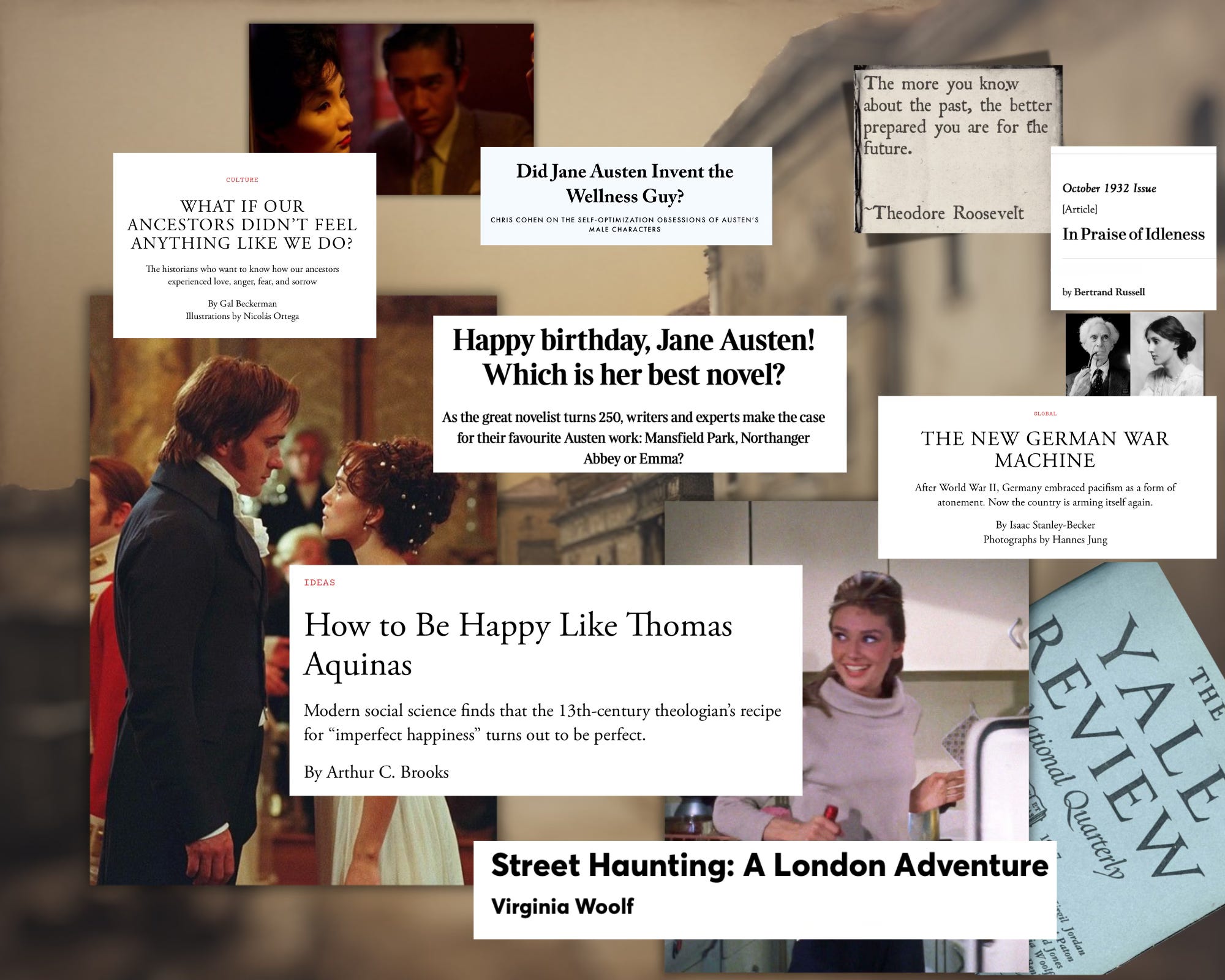
Featured this week:
Germany’s uneasy return to military strength; Thomas Aquinas’s surprisingly modern theory of happiness; debates around Jane Austen — her greatest novel and what her satire of early “wellness” culture warns us about; revisiting Virginia Woolf through biography, diaries, and one of her best published essays at The Yale Review; on medieval symbolism; how our emotions differ from our ancestors; a fascinating piece on the political psychology of groups; critiques of abuse in classical music.
This week’s classics: Closing with classic defenses of idleness from Bertrand Russell and Virginia Woolf, questioning what we owe work, leisure, and the past.
This week’s essays are from Litery Hub, London Review of Books, The Atlantic, The Times, Aeon, n+1, Public Books, The Yale Review.
About The Weekly Reading Guide series: Includes the best pieces of contemporary writing — essays, op-eds, and articles — from great and rare corners of the internet and media. If you don’t have time to scour online newsstands, are tired of the same circulating stories, and want to stay up-to-date on a more eclectic roundup of current cultural, social, political, literary, and artistic conversations, I hope you find this series useful.
About This Week’s Classic Essays: Part of The Weekly Reading Guides, features essays from the classical canon to mix up current reads with foundational texts.
Read previous guides:


Monthly Postcards series: Books, films, reflections.

[Dec 8 - Dec 13, 2025]
This Week’s Classic Essays
If you haven’t read it yet, this essay from last week was my most-read. Drawing on philosophy and literature, it’s a personal reflection on the lost art of doing nothing—and our urgent need to relearn it. I shared 20 ways to practice it, along with artwork that captures the idea visually. I hope you had a chance to read it. I’m still riding the wave of those thoughts, which is why this week’s classic essays feel perfectly aligned. Woolf writes about a nighttime walk through London under the pretext of buying a pencil, while Russell dismantles the harmful rules we’ve inherited about work. Aristotle once said that leisure is the goal of civilization—these essays are a powerful reminder of that truth.

In Praise of Idleness - Bertrand Russell (Harper’s, 1932)
Russell argues that the modern glorification of working long hours is not morally good or necessary, but a harmful inheritance from older, unequal, preindustrial, class-based societies. Because modern technology can meet everyone’s needs with far less labor, he believed people should work no more than four hours a day and enjoy more leisure. He critiques the idea of “work as virtue” and “the dignity of labor” suggesting it has long been used by elites to control others while reserving leisure for themselves. He maintains that leisure, not toil, is the true foundation of civilization, creativity, and social progress, enabling art, science, education, and democratic life to flourish. Russell envisions a society in which widely shared leisure leads to greater happiness, kindness, creativity, and peace, replacing exhaustion, inequality, and the moral obsession with profit-based productivity.
Street Haunting: A London Adventure - Virginia Woolf (The Yale Review, 1927)
Woolf says that a simple errand — buying a pencil — is a socially acceptable excuse to wander the city and escape the usual self tied to home, habits, and responsibilities. Walking through London at night lets her become an observer rather than a fixed person, freely noticing shop windows, strangers, and small moments of beauty. This is Virginia Woolf’s slow living and her art of doing nothing. As she walks, her attention keeps nagging on human lives, revealing moments of connection alongside the city’s deep inequalities. When she finally returns home, her everyday self closes back around her again, but the walk has given her a temporary “spoil” and proof that escape, even briefly, is possible.
Bonus Read
Smashing the Teapots: Where’s Woolf? - London Review of Books (1997)
This is a review of Hermione Lee’s biography of Virginia Woolf, which I have not read. I’m including it because the final volume of Woolf’s unpublished diaries was released this year, and some of that long-withheld material — including offensive remarks — has rightly prompted renewed scrutiny. I deeply admire Woolf’s literary achievement, but admiration for artistic brilliance does not require moral endorsement. Her work cannot be fully understood without attention to both her private suffering and the historical forces that shaped her world — war, fascism, and antisemitism — which informed her style and her preoccupation with loss and trauma. To present Woolf as simply healthy or fully in control risks overlooking how contradiction, prejudice, and mental illness shaped her critique of what passed for a “civilized” society.
A word on critically reading the classical canon:
Writers such as Shakespeare, T.S. Eliot, Ezra Pound (open fascist), Dostoevsky, Hemingway, Rousseau (all men, not women, are created equal), and many more, all used language or expressed views that were deeply troubling, and morally suffocating. Many of us encountered their work before fully understanding the historical realities that shaped them. As readers in the present, it’s our responsibility to know not only what we’re reading, but who we’re reading — and from what era. Context doesn’t excuse prejudice, but it allows us to read critically rather than blindly.
This Past Week’s Best Pieces of Writing
Note: My guides span every corner of thought. Each brings its own light. The aim is to read widely, think critically, and notice where ideas meet and where they part. No school of thought should be a fan club. Accountability, nuance, and the ability to take compassionate, principled stances are the only grown-up postures in life, society, and culture. Let’s think for ourselves and find common ground.
How to Be Happy Like Thomas Aquinas — The Atlantic
Thomas Aquinas was instrumental in bringing together Christian faith and the logic-driven philosophy of Aristotle. He believed that faith and reason did not need to compete with one another—a view so influential that his summary of Christian doctrine is still used by the Catholic Church today. Considering this was 13th-century Europe, the fact that no one asked him to drink a glass of hemlock and be quiet seems something of a mystery. Remarkably ahead of his time, he believed that while perfect happiness belongs to heaven, “imperfect happiness” on Earth is possible through balance: rather than suppressing emotions, he argued we should be understanding and guiding emotions (beating modern therapy by centuries), building good habits, and choosing long-term meaning over short-term pleasure. The article shows how closely his ideas match modern happiness research — and Aquinas practiced what he preached by choosing humility over prestige. Aquinas: still winning, centuries later.o.
The following two essays are from last week’s run — I didn’t have time to read while I was undisposed but finally got to them and wanted to squeeze them in!
What If Our Ancestors Didn’t Feel Anything Like We Do? — The Atlantic
As someone who tears up during movies that are supposed to be action comedies, I’ve come to realize what a privilege it is to feel so freely today. For much of human history, people seem to have repressed their emotions far more than we do now. Had they paid attention to Aquinas, perhaps things would’ve gone differently. Historians argue that people in the past didn’t experience emotions the same way we do — feelings like pain and anger were shaped by culture, religion, and daily life, not universal human constants. Instead of assuming we can easily relate to past emotions, the writer suggests studying the worlds that gave those feelings meaning, such as medieval pain tied to Christ’s suffering or Greek anger seen as cosmic disorder. What connects us across time may not be identical emotions, but curiosity about how others experienced the world. It makes sense. What triggers our emotions depends entirely on what we were taught. Some people get angry when they don’t get what they want because they were never denied; others cry when struck, while some respond with rage. It’s all relative.
Which is the best Jane Austen novel? - The Times
The Times staging a staff debate over this holy question is a delightful way to celebrate Austen’s 250th birthday (happy birthday, lass!). Each novel is a strong contender: Sense and Sensibility is praised for its youthful drama and emotional realism; Mansfield Park for its moral depth; Northanger Abbey for its humor and metafictional playfulness; Emma for its technical brilliance and psychological insight; Persuasion for its quiet maturity; and Pride and Prejudice for its unforgettability and swoon-worthy tension between desire and restraint. Each book represents a different stage of Austen’s growth as a writer. What’s your favorite? All answers are correct.
Medieval moons - Aeon
Today, the Moon is simply our planet’s beloved natural satellite. Back in the medieval times, it was far more magical. The phase-changing white angelic globe was a sign filled with meaning. In Christian thought, the Moon symbolized everything from the Church’s dependence on Christ to Christ’s human nature. In Islamic tradition, it took on a more spiritual role as a symbol of devotion to God, while in Sufi thought, forever profound and straight-up, it was God Himself. Seen through lenses of faith, power, and humanity’s search for meaning — long before Galileo’s telescope revealed it to be just… rock — the Moon was, for medieval thinkers, a mystical symbol written across the sky.
Experiences in Groups - n+1
This was such a fascinating essay — if you read nothing else on this list, read this. Lily Scherlis writes about her immersive experience at a conference devoted to “group relations,” a prestigious social experiment that studies unconscious dynamics in group. Strangers are placed together in a room with no agenda, formal roles, or facilitation —to see what happens. The goal is not to argue or vent but to understand better. Through that void, group dynamics are studied. later connects this to her experience at a Gaza solidarity encampment, where she experienced such a profound sense of belonging with the people she chanted alongside that it was difficult to give up once it was over. As Freud suggested, being in a group can feel like hypnosis. Under stress, groups tend to fall into dependency, conflict, or messianic hope, sometimes overburdening individuals until they break. Unstructured group settings can intensify emotion, bring up power struggles, and assign individuals functions they’re not even right for. For instance, if you don’t designate a leader, a “charismatic narcissist ascends de facto.” While the writer remains unsure whether group relations is politically useful, since it can be easily misused, she concludes that groups are unavoidable—and learning to tolerate their discomforts may be essential if collective action is to endure.
Did Jane Austen Invent the Wellness Guy? - Literary Hub
Jane Austen arguably “invented” (or at least prefigured) today’s Wellness Guy through her satire of men obsessed with health, routines, and self-improvement. Characters like Mr. Collins, Mr. Woodhouse (gruel for everyone!), and Sir Walter Elliot constantly worry about diet, aging, and propriety in ways that feel surprisingly modern—Sir Walter, for instance, is personally offended by sun-damaged skin in Persuasion.It’s not saying that wellness is a bad thing — it’s a great thing. UV damage is real. But the obsession over wellness can reveal vanity, privilege, narcissism, and class insulation while ignoring deeper moral and social problem. Fixating on youth and “lifestyle choices” doesn’t make anyone wiser or kinder, and it can delay intimacy and adulthood. Young people still have to solve love and life’s real challenges. To them the writer says, “you don’t have to eat the gruel yet.”
Can Literary Fiction Save Classical Music? - Public Books
I was shocked to read this. A recent wave of literary fiction has exposed classical music’s cultures of abuse, bodily exploitation, entrenched racism, and gender inequality. Drawing on several contemporary novels, the writer reveals the industry’s shockingly harsh labor practices and exclusionary histories, including the severe physical and psychological toll placed on musicians — especially agonizing in a field where physical health is inseparable from one’s vocational livelihood. Classical music has recently had a pop-culture moment, and hopefully that visibility, alongside modern fiction, can help hold the industry accountable and push it toward more ethical artistic futures. I’m exhausted by stories of powerful, repressed figures choosing Machiavellian control over basic humanity. Too many industries suffer from this disease. Leadership without compassion is hollow — and until that changes, it will keep dragging everyone down with it.
Critical Thinking
Where do you see tension between control and freedom in these essays — whether in work, art, emotion, bodies, or groups — and where do you feel that tension most strongly in your own life? Think about productivity vs. leisure, wellness vs. vanity, discipline vs. joy, group belonging vs. individuality.
Several of these writers question inherited moral ideals — hard work, sanity, self-optimization, authority, or “civilized” behavior. Which belief did this collection make you most want to reconsider, and why? You might think about Russell on work, Woolf on madness, Aquinas on happiness, or Austen on propriety.
Many of these essays ask what it means to live well together — in nations, institutions, art worlds, or movements. After reading them, what do you think responsibility to others should look like in a fragile or unequal world?Consider Germany’s rearmament, group dynamics, historical empathy, or care versus exploitation in creative fields.

Love the concept of this profile!!