


formerly, the weekly reading guide — a note on the change below
The commonplace book is one of the oldest and most intimate of literary traditions — a private, personalized, central repository for organizing quotes, ideas, observations, and information — often called a “second brain” or “thinker’s journal” — and a record of everything that has arrested the attention.
During the Renaissance, the commonplace book was standard practice among serious readers — John Locke developed an indexed, systematic methodology for his, John Milton documented his reading, Virginia Woolf used hers for planning and collecting ideas, and Arthur Conan Doyle used his to transcribe research for stories.
I have kept several physical journals and commonplace books for years — handwritten reflections on everything I read and watch, and reflect upon, organized by theme or obsession.
some journal pages from my physical commonplace book
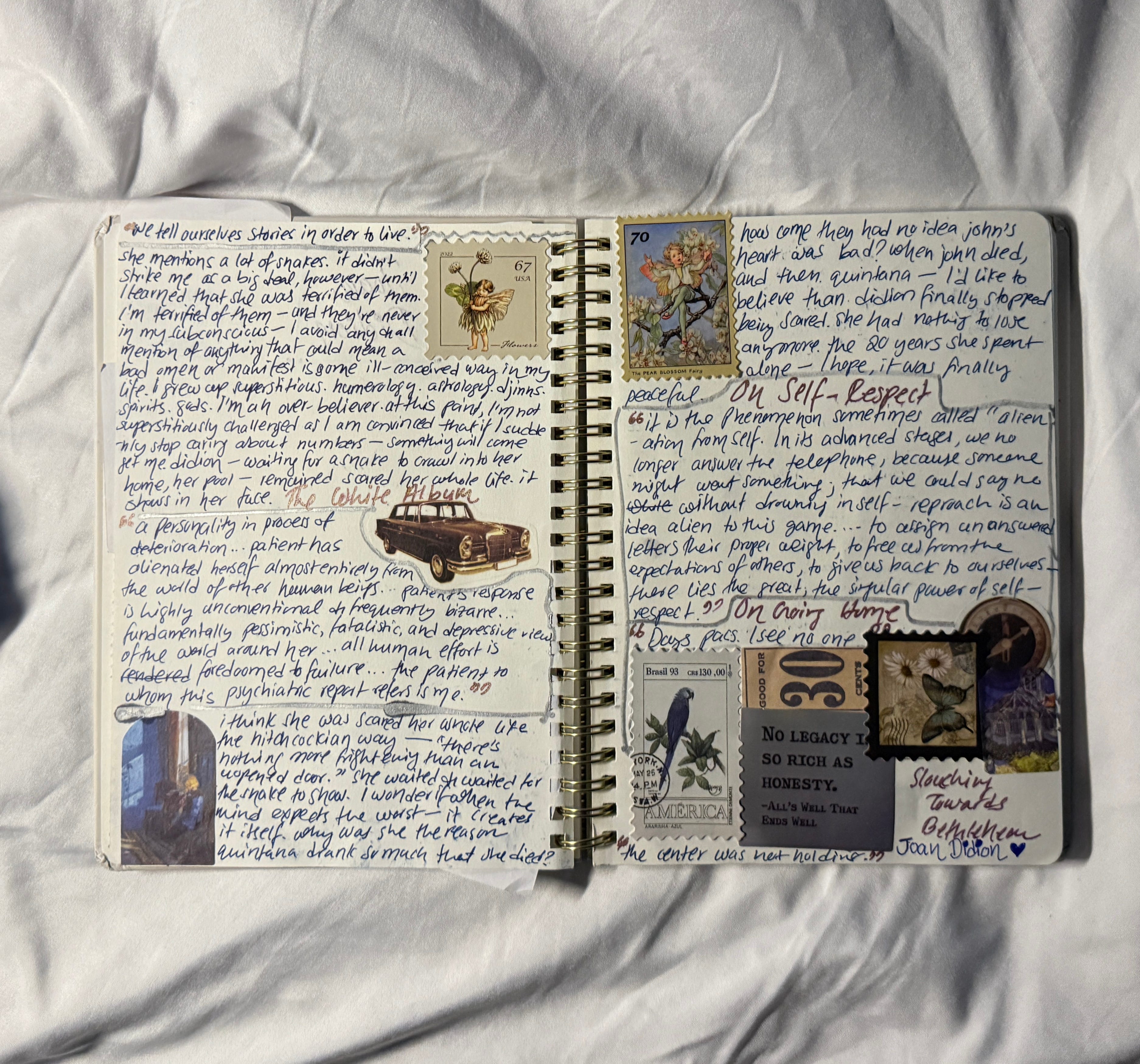
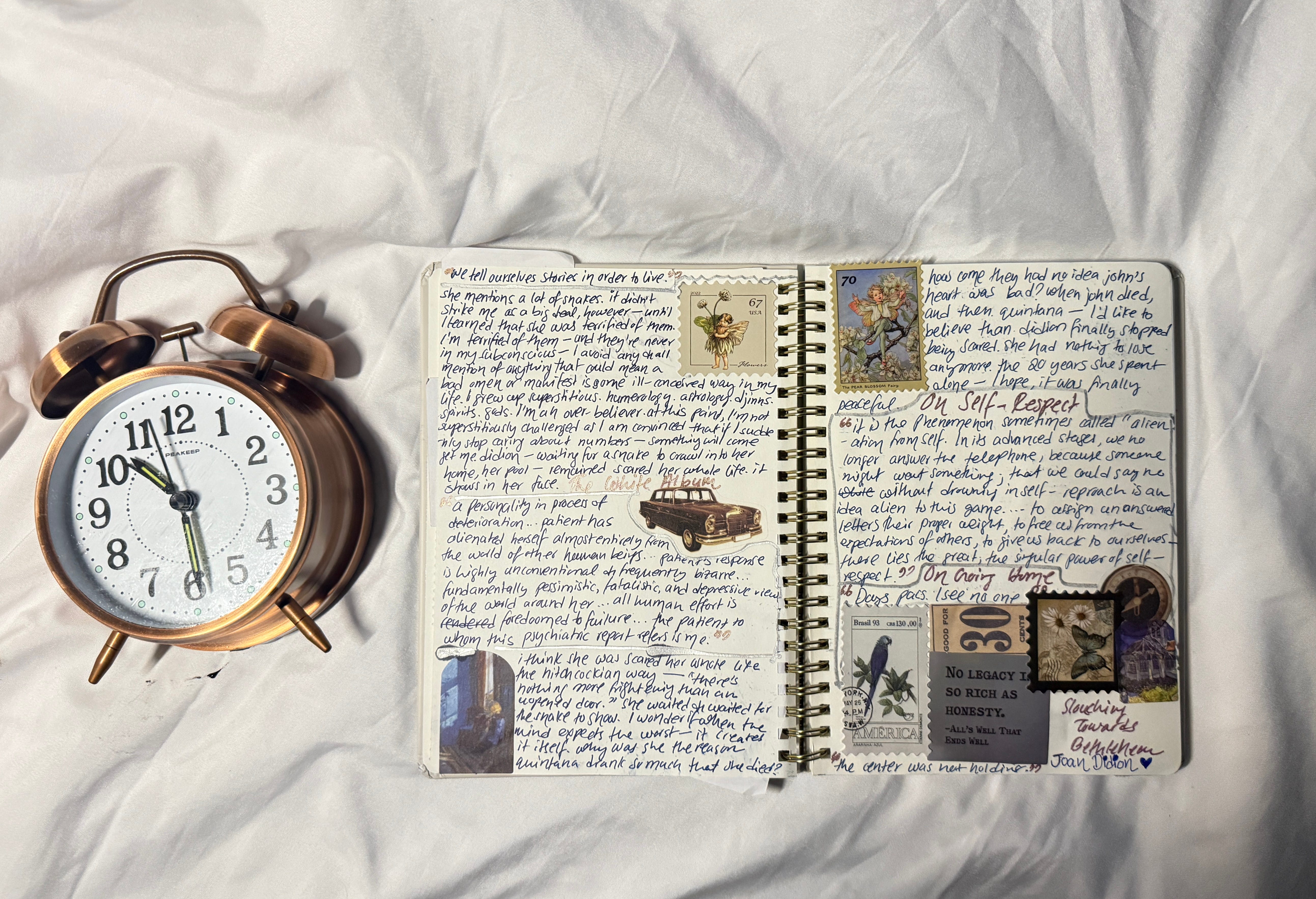
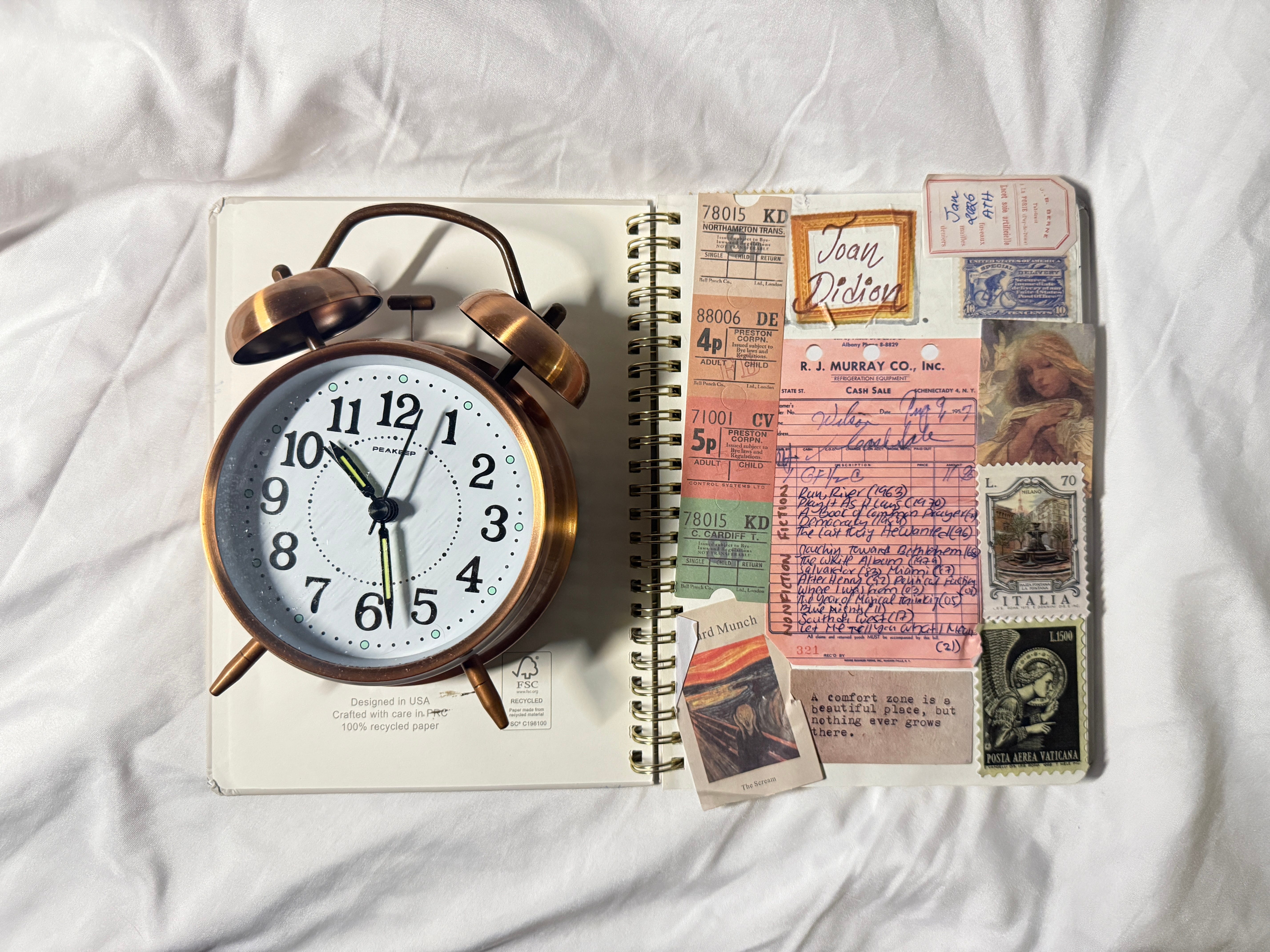
I began The Weekly Reading Guides last autumn. Twelve volumes later, it has become a public commonplace book of sorts — an accumulated record of reading and its afterthoughts.
After working in the corporate sector for nearly a decade, reading — once an instinctive habit from the age of five or six — had become rote and impersonal, and in any meaningful sense, rare. Instead, it resembled a never—ending list to be tracked and counted, and gamified. I hardly had a moment — temporally or mentally — to sit with a book intimately and without a clock ticking. For the library of babel is humungous, and days of our lives numbered. The scope exceeds what can be reasonably covered in a single pass of a lifetime. I know I will not read them all. But rather than accepting this limit, most of us try to outrun it by powering through as many books as possible before we die — which defeats the point of reading for pleasure.
The slow philosophy grew out of this conundrum as a solution to the madness. At first, I began a habit of walking across the street to my local newsstand to buy newspapers to read with breakfast. During college, my studies almost required this practice, but not much since then. Working a hundred and twenty hours a week hadn’t left room for the paper, much less the splendid literary magazines still active in circulation with admirable gusto. But I attempted a few at a time and noted down afterthoughts into my notebooks. In putting together these twelve volumes, I engaged deeply with literary essays on science, literature, philosophy, society, culture, and anything else that gets under my skin and doesn’t look like the same stories circulating on the front pages. In time, short-form reading served as a neat gateway back to more ambitious reading as well.
To that end, I also put together a monthly postcard — something more spacious that included reflections on books and poetry read, as well as film and music. In doing so, rather than simply passing through me, not only did anything I consumed gather into an archive for me to look back on, but it also helped me forge a more lasting relation to what I had read, seen, and heard.
Keeping records, journals, diaries, and archives of my life has come to feel essential. It is a way of accounting for what matters, of not letting it disappear entirely.
This space has always been an argument for slowing down, depth, and genuine engagement. It seems necessary to apply that argument to the postcard itself. Going forward, the Weekly Reading Guides will become The Commonplace Book — curated snippets of my reading. Each week, I’ll cherry-pick one or two classical essays paired with one or two contemporary ones with my critical reflections, questions, and, of course, links to the original texts.
Without further ado, here is the first commonplace book postcard — volume 13.
featured this week

Classic essay —
By Henry Adams.
Contemporary essay —
From Lit Hub.
Read previous guides:


[March 2026]
Contemporary Essay of the Month

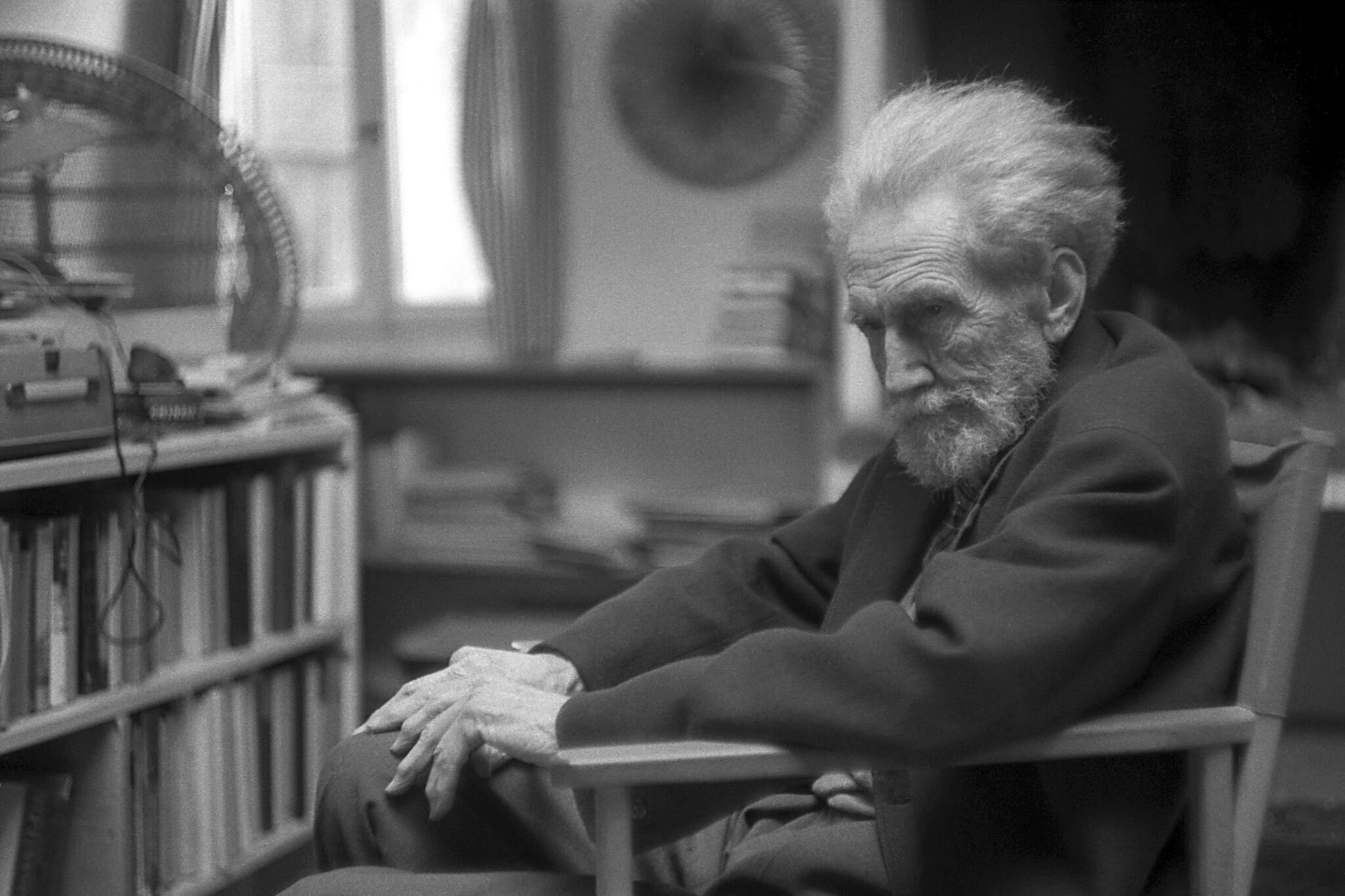
Reading “Literary Celebrity, Mussolini’s Mouthpiece, AND American Traitor: Who Was Ezra Pound?” — Lit Hub
To the controversial debates of how to separate art from artist, I add Ezra Pound. Twentieth-century poetry’s celebrated dean. Mentor to T.S. Eliot, Ernest Hemingway, W.B. Yeats, James Joyce, Robert Frost, Marianne Moore, and William Carlos Williams. And virulent Anti-Semite.
An ardent supporter of Mussolini, Pound lived in Europe for three decades and sailed to America in 1939 to warn against American involvement in the war, even offering Mussolini’s Ministry of Popular Culture help countering anti-fascist propaganda. Once his fascist credentials were verified, he began broadcasting Mussolini’s achievements and promoting fascism as the only remedy for social injustice over the radio — all in exchange for a monthly salary and travel perks from the Italian government. Yup, he was a paid fascist.
Eventually, Roosevelt said what the fuck. He sent a memo to his Attorney General asking why on earth Pound, broadcasting for the goddarn Axis, hadn’t been indicted for treason already.
The FBI, on the other hand, stepped in and was like — oh, Mr. President, don’t you worry, this man has no idea what’s coming. We have been fattening him up for just this occasion.
Turns out, they had already been building a file on Pound. When FBI agent Frank Amprim arrested Pound in Genoa and questioned him — Pound, so fucking self-important and unaware of how much shit he was in — asked to send a telegram to President Truman, offering to “broker peace” with Japan, requesting permission to make a final radio broadcast. Amprim, obviously, said “nope.”
Harding writes: “That Pound was shocked when Amprim declined both requests gives a clear idea of the poet’s stunning naïveté and overwhelming sense of self-importance.”
Ezra, on the other hand, went on to write: “I do not believe I have betrayed anyone whomsoever.”
My favorite part of this whole affair was how Amprim maintained a calm and friendly manner throughout the questioning — as Pound freely admitted to all his guilt and praised the Nazis. Pound, a brilliant poet for all his authority, was so clueless that he actually thought — oh, that FBI agent? Yeah, he was totally convinced by me — I’m good. Unbeknownst to him, of course, accounts say that Amprim had to count the goats in his head so as not to strangle Pound in slow motion while listening to him praise Hitler.
In the end, Pound was never tried for treason. He was found mentally unfit to stand trial and committed to St. Elizabeth’s Hospital for the criminally insane in Washington, D.C., where he spent thirteen years. Upon his eventual release in 1958, he returned to Italy and died in Venice in 1972.
T.S. Eliot’s original manuscript of The Waste Land was an actual waste land. Nearly twice as long and fragmented. Pound came in and cut it into a lean half. He edited it so aggressively that Eliot dedicated the published poem to Pound with the phrase “il miglior fabbro” — "the better craftsman," a fancy Latinate phrase borrowed from Dante. Pound was also the reason T.S. Eliot’s Prufrock poem got published. Without Pound, there would probably be no Eliot.
Or Ernest Hemingway. Hemingway arrived in Paris in 1921 as an unknown journalist. Pound, ever the mentor figure, took him under his wing as well, critiqued his prose, and pushed him toward the stripped, declarative style that would come to define him. Hemingway later said Pound taught him more about writing than anyone else (I hope Gertrude Stein was okay hearing that…), and repaid the debt by campaigning loudly for Pound's release from St. Elizabeth’s decades later.
Pound also served as W.B. Yeats’s secretary for three winters in the early 1910s, and pushed the older, more romantic Yeats toward harder, more concrete imagery.
And of course, James Joyce. Championed by Pound tirelessly (and that whole troupe — Eliot, Hemingway) before anyone knew who he was, Joyce would not have been published if it weren’t for Pound arranging for A Portrait of the Artist as a Young Man to be serialized, helping get Ulysses published, and securing Joyce financial support when he was destitute. Joyce acknowledged that without Pound's early advocacy, his career might never have gotten off the ground.
Isn’t Pound so great? He was a big deal in the world of literature and could have easily cut everyone else out — but it’s nice to hear the dude was secure enough in his own craft to help launch so many careers. What a solid dude. Sounds almost fictional.
Yes, I always thought this whole business with Pound being so generous and uplifting to other talent was too good to be true. Maybe I’ve become a cynic. But the more I dug, the more I notice the problems under the surface.
He had plenty of friends, sure. But, to be fair, most of these people were hugely indebted to him. What happened if they stopped treating him like he was their god?
Let’s ask Robert Frost. Robert Frost hated Ezra Pound. (I read about it in an essay I read in the London Review of Books that I found pretty hilarious.)
Pound reviewed Frost’s first book enthusiastically in 1913 when Frost was entirely unknown — one of the first serious critical notices the poet received. But Frost was prickly, competitive, and fiercely protective of his own reputation and independence. He didn’t like being positioned as someone Pound had discovered or sponsored. He felt it diminished him, made him seem like one of Pound’s projects rather than his own man.
Frost also found Pound’s persona insufferable: the performative bohemianism, the affected speech, the constant posturing as the arbiter of all that was modern and worthwhile in literature. Pound collected acolytes and expected gratitude and deference. Frost was not built for either. I can imagine Hemingway and Eliot, two very smart people, sucking up to Pound for success. To that end, I can also imagine Frost, a man I can’t imagine kissing anyone’s behind, saying, to all that: no chance in snowy evening hell. That’s a road I ain’t taking.
Later in life, Frost was openly dismissive of Pound, and notably did not join the chorus of writers — which included Hemingway and Eliot — who campaigned most urgently for Pound’s release from St. Elizabeths. Frost did eventually play a role in securing Pound’s release in 1958, but characteristically managed to position himself as the one who actually got it done, somewhat elbowing aside the others who had been working toward it far longer. Robert Frost farmed so much aura in his time, I swear to God.
Nabokov famously hated Pound as well — calling him “that total fake.”
William Carlos Williams was one of Pound’s oldest friends. They met at the University of Pennsylvania around 1902, and their friendship lasted for decades. But, not surprisingly, Williams grew deeply frustrated with Pound’s expatriatism, fascism, and grandiosity as well. Williams stayed in America, worked as a doctor in New Jersey, and built a type of poetry rooted in American vernacular speech. He felt Pound and Eliot had done American poetry a disservice by dragging it toward European tradition and obscurantism, which makes complete sense because Eliot, in his famous essay on “traditions,” literally said that the goal of an American man was to become European — the hub of all hubs.
I always thought that there was something really weird about their Eurocentrism. I don’t mind them being expatriates, but to assume that they had been rebaptised as Europeans? It’s kind of like Mr. Getty — an American rich trust fund baby declaring himself a European aristocrat — when you’re neither of those two words. That’s taking “fake it till you make it” way too far, if you ask me.
Anyway, after the war and the treason indictment, Williams largely withdrew from defending Pound.
Gertrude Stein (the person Hemingway SHOULD be thanking above everyone else!) famously clashed with Pound, finding him tiresome and juvenile. She reportedly said that he was a village explainer — which was fine if you were a village. Coming from Stein, herself not exactly known for self-effacement, that was a pretty huge dismissal.
I’m sure Eliot and Hemingway loved Pound like an elder brother and loved owing their success to him, and didn’t mind that Pound demanded to be the center, the teacher, the taste-maker, but I’m also sure that there is a sense of grandiloquence there that they also happily ignored. Many people found it tolerable when they were young and needed the help, and intolerable once they had their own standing and no longer needed his approval.
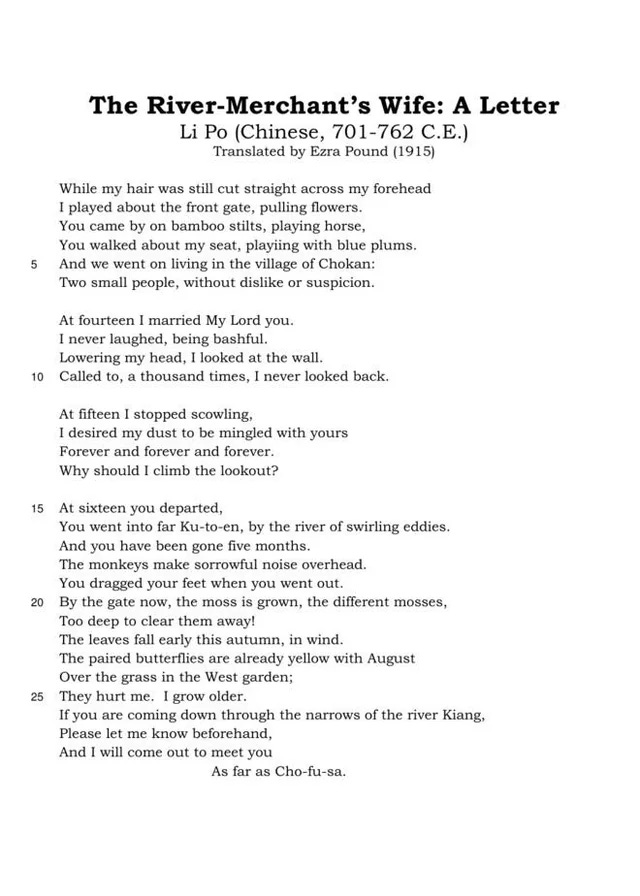
As fascinating as I find all this background on Pound and his impact on literary figures and literature, what makes it so unsettling in light of the Lit Hub article, is the timeline. Pound was doing much of all this… extraordinary literary work — editing Eliot, mentoring Hemingway, championing Joyce — in the 1910s and 1920s, the very decades during which his political thinking was also becoming fascist and anti-Semitic and dark as hell. These weren’t separate phases of his life. They overlapped. The man generously midwifing some of the greatest works of the 20th century was simultaneously developing the ideology that would land him in a psych ward in Washington. That coincidence is what makes Pound such an enduring and uncomfortable figure — you cannot exactly separate the genius from the poison that he had become.
Classical Essay of the Month

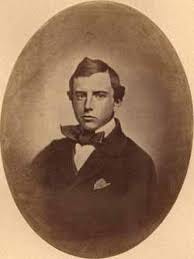
Reading “A Law of Acceleration” — Henry Adams (1905)
If you were born in 1838, you’d be brought into a world of candles, horses, and sailing ships. But by the time you died, you’d have lived to see electric lights, automobiles, and wireless telegraphy. But Henry Adams had more problems than that. He was a man of the nineteenth century — grandson of one American president, great-grandson of another, Harvard-educated, a historian of the old school — and the twentieth century was arriving whether he liked it or not. He did not like it.
A smart man ahead of his time, he had the wisdom to sense that the curve of scientific progress was still bending upward, steepening toward something his generation had no conceptual vocabulary whatsoever to name.
And so he wrote this essay. In it, he prophesied that the laws of acceleration would produce a scientific force far too great for the human intellect to absorb. And that he’d be long gone before finding out how fast the comet would go.
“A Law of Acceleration” is the penultimate chapter of The Education of Henry Adams, and it reads less like an essay and more like a very elegant, very polite panic attack. Adams surveys the whole arc of human history through the lens of “forces” — what draws the human mind forward, what it orbits, what it gets sucked into. For most of civilization, these forces were manageable. Theology. Philosophy. Scientific curiosity accumulating slowly.
Then the nineteenth century happened.
Between 1840 and 1900, coal output doubled roughly every ten years. Ocean steamers went from 234 horsepower in 1835 to 30,000 by 1905, the Curies discovered radium, and Röntgen found X-rays. In the span of a single lifetime, Adams watched four “impossibilities” become ordinary reality — the ocean steamer, the railway, the electric telegraph, the daguerreotype. He was absolutely terrified.
The human mind, he argues, is like a comet dropping from space in a straight line, accelerating directly toward the sun — gathering speed with every passing year, pulled by forces it can barely comprehend. What happens when it gets there? Does it whip around and come back, defying the laws that should have destroyed it? Or does it burn up?
He was writing this in 1904. He thought things were moving fast then.
Plenty of people were pessimistic at the turn of the century — it was practically a hobby — but what sets Adams apart is how specific he was about it. The rate of knowledge accumulation had so far outpaced the human mind’s ability to process it that something had to give. The movement from unity to multiplicity — from one coherent worldview to the fracturing chaos of modernity — had been “unbroken in sequence, and rapid in acceleration.” Prolonged another generation, he warned, it would require a new social mind entirely.
And Adams knew he personally wasn’t going to make the jump — from the kind of mind the nineteenth century had produced into whatever new cognitive mode the twentieth actually required. He no longer wanted to be teacher or even friend to the new American being born in 1900 — he asked only to be a pupil, and promised to be “docile, for once, even though trodden under foot.” A man from one of the most distinguished families in American history, a man who had sat next to Bismarck and Lincoln and Henry James at dinner — saying that — pretty noble. We could all learn from it.
Humility, I would say, is pretty much missing in action right now. But we would be good to bring it back.
Science was accelerating so fast that scientists were equally lost there for a bit. The most elementary science textbooks of his era kept ending chapters with phrases like: “the cause of this phenomenon is not understood” and “science no longer ventures to explain causes” and “opinions are very much divided.” The scientists couldn’t explain the forces they themselves were unleashing — why radium behaved the way it did, what electricity fundamentally was, what the deeper causal logic behind any of it looked like. They could measure the acceleration. They could describe it. They couldn’t tell you where it was going or why. If the scientists driving the car didn’t know how the engine worked, what hope did a historian have? Adams, understandably, lost his mind a little.
Learn how to react. Learn how to survive contact with what’s coming. Pretty good advice.
Adams wrote, with complete sincerity, that at the rate of progress since 1800, every American living into the year 2000 would “know how to control unlimited power.” Would “think in complexities unimaginable to an earlier mind.” Would look back at the nineteenth century the way we look back at the fourth — as equally childlike. He meant this as hope. A vision of the new American as “a sort of God compared with any former creation of nature.”
Reader, look around.
AI is probably the “leap” he was anticipating, the new phase of mind that could handle the complexities accumulating beyond human capacity. But Adams thought unlimited power and unlimited wisdom would arrive together. He didn’t account for the rather significant possibility that the power would show up a few centuries early and the wisdom would get stuck in traffic.
And of course, look at today. Henry Adams was sure that the civilization he knew was being transformed in ways that he and the humanist class he represented simply could not comprehend. If he had been able to foresee the chaos of human suffering initiated by scientific “progress,” the poor man would have recoiled in horror. But honestly, he probably wouldn’t be surprised. The mind, he warned, had entered a field of attraction so intense it would either have to make a great leap to a new equilibrium — or be dissipated entirely, like a meteoroid burning up in the atmosphere.
Welp. I hope that’s not where we’re headed.
Reading Notes
Henry Adams feared the mind could not keep pace with the forces it had unleashed. I would say Ezra Pound proved him right — a man of extraordinary intellectual power, destroyed by the very acceleration of history he inhabited.

Your journal is so enviable wowwww
I love that you are rebelling against the capitalist machine of consumption and taking back control in how you engage in the things you enjoy. Your revolution will not be televised ☺️!