


Happy New Year, and welcome back. For those new, these guides are a curation of short, neat, and clean lists of the best writing I can find. I choose what I want to read — literary essays on science, literature, philosophy, sociopolitical ideas, and anything else that gets under my skin. My guides work because they don’t overwhelm. I organize the material well, and place contemporary essays alongside classical essays. In previous guides, these have included Orwell, Wilde, James, Woolf, Sontag, and more. My goal is to spare you the tension headache of figuring out what’s worth your time and lend some meaning to the egregious amount of time I already spend doing it. If your life is full and attention finite, read the blurbs and follow your curiosity.
Without further ado, here’s volume nine.
Featured this week:
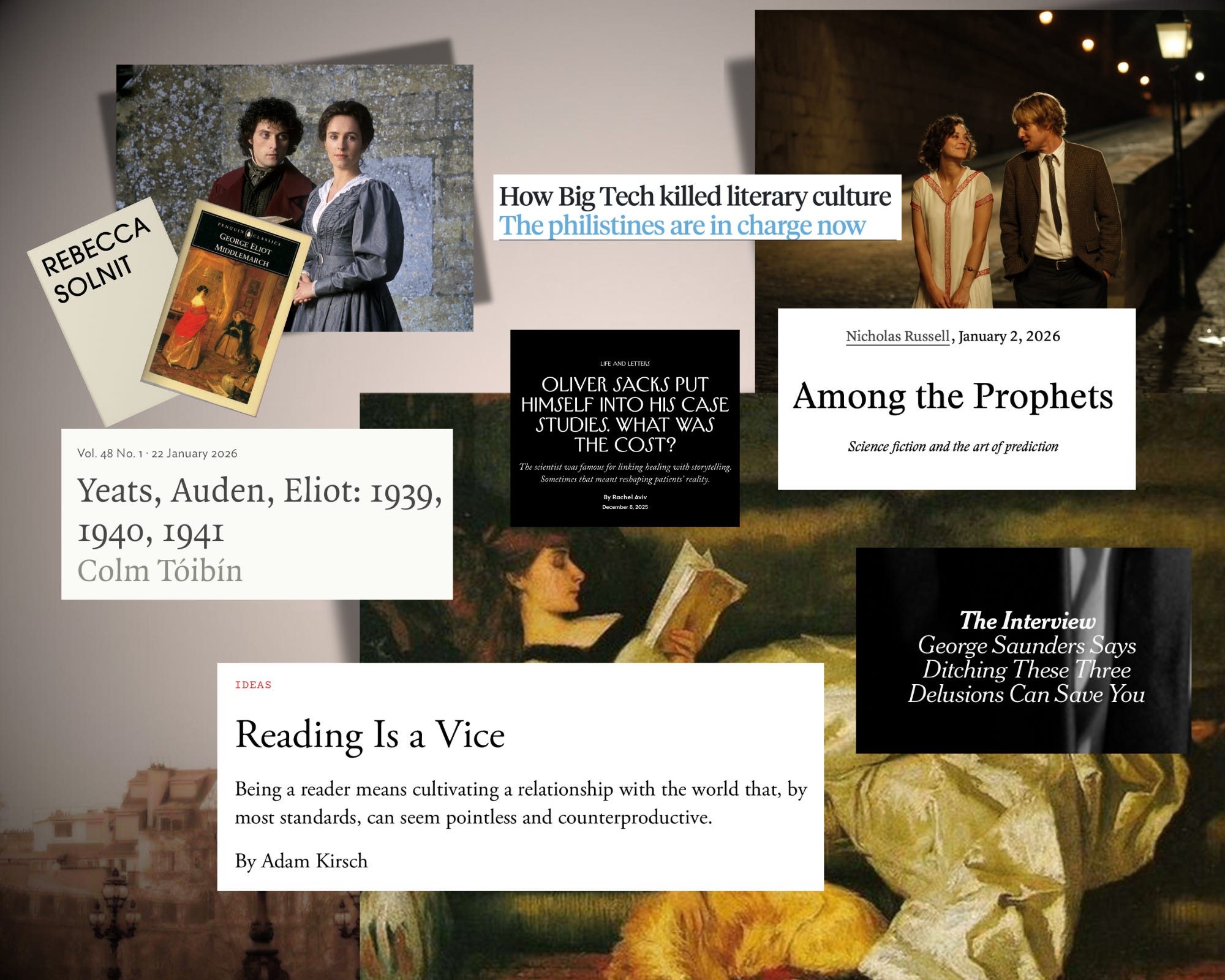
Two classic essays — one each by George Eliot and Rebecca Solnit.
Alongside them, contemporary op-eds on:
The private struggles of poets (Yeats, Auden, Eliot); an interview with George; a unique pov on reading’s decline; Big Tech’s takeover of literacy; science fiction’s uneasy relationship with the future; the future of publishing. Bonus: two pieces on Oliver Sacks.
This week’s list spans The New Yorker, The Atlantic, The New York Times, The Baffler, London Review of Books, UnHerd, Liberties.
About The Weekly Reading Guides: A curated selection of the best essays, op-eds, and articles from great — and often overlooked — corners of the internet and media. For readers who don’t have time to scour online newsstands, are tired of the same circulating stories, and want thoughtful engagement with current cultural, social, political, literary, and artistic conversations.
Each guide also includes a This Week’s Classic Essays section, pairing canonical texts with guiding questions for deep reading — to mix up current reads with foundational texts.
Read previous reading guides:


More from the slow philosophy
Monthly Postcards: Books, films, poetry, playlists, comforts. Read the latest:


[Jan 1 - Jan 18, 2025]
This Week’s Classic Essays
This week’s essays, written more than 150 years apart, speak to the same enduring question: how women are granted — or denied — intellectual authority. George Eliot writes from within the nineteenth-century literary world, scrutinizing the standards by which women write and are judged, while Rebecca Solnit addresses a contemporary culture in which women’s knowledge is routinely dismissed or overridden. Read together, these pieces offer a long historical lens on credibility, voice, and the struggle to be taken seriously, revealing how the problem has shifted in form but not in exactly in essence.
George Eliot (Mary Ann Evans) - “Silly Novels by Lady Novelists” (Westminster Review, 1856)
George Eliot, who gave us the gift of Middlemarch, satirically criticizes a large body of popular women’s fiction for being shallow, pretentious, and disconnected from real life, arguing that many female novelists substitute vague moralizing, exaggerated emotion, social snobbery, and pseudo-intellectual language for genuine observation and artistic discipline. She identifies several “species” of bad novels — from glamorous “mind-and-millinery” romances to preachy evangelical and pseudo-philosophical “oracular” works and historically dressed-up fantasies— all of which, she claims, confuse bombast with depth and imitation with originality. Eliot’s central point is not that women lack literary talent, but that mediocre writers (encouraged by flattery and low standards) damage the reputation of women’s intellect by mistaking ease of writing for mastery; truly cultivated women, she insists, write with humility, precision, and sympathy, and the problem is not women writing, but writing without intellectual rigor, self-criticism, or real engagement with human experience.
Rebecca Solnit - “Men Explain Things To Me” (Guernica, 2008)
A modern classic, in this essay, Rebecca Solnit examines how a culture of male overconfidence and female self-doubt silences women, using a series of personal anecdotes — most famously, a man confidently explaining her own book to her. Solnit identifies what would later be named “mansplaining,” and reframes it not as a trivial social tic but as a structural pattern that undermines women’s credibility, discourages them from speaking, and trains them to mistrust their own knowledge. She connects everyday condescension to more serious forms of silencing, including sexual violence and the legal and cultural refusal to believe women, suggesting that credibility is a basic survival tool. Ultimately, the essay frames “mansplaining” less as a joke and more as a symptom of deeper epistemic injustice: a world in which women must fight not only for political rights, but for the simple right to be heard and taken seriously as knowers of their own experience.
Critical Thinking:
Do Solnit and Eliot see women’s lack of credibility as mainly imposed from the outside or shaped from within?
What do these essays suggest about whether authority is something women must claim, earn, or are unfairly denied?
The Past Weeks’ Best Pieces of Writing
Note: My guides span every corner of thought. Each brings its own light. The aim is to read widely, think critically, and notice where ideas meet and where they part. No school of thought should be a fan club. Accountability, nuance, and the ability to take compassionate, principled stances are the only grown-up postures in life, society, and culture. Let’s think for ourselves and find common ground.
Yeats, Auden, Eliot: 1939, 1940, 1941 - London Review of Books
A deep glimpse into the lives of poets struggling to put words on paper amid the pressures of their circumstances—and how those circumstances shape the work itself—this essay follows three writers bound by influence and doubt: William Butler Yeats, T. S. Eliot, and W. H. Auden. Yeats, who gave us “The Second Coming” and “The Lake Isle of Innisfree,” wrote his final poem, “Cuchulain Comforted,” just days before his death, a piece radically unlike much of what he had written before; the author traces it almost word by word, revealing the deliberate, fragile choices behind it. Auden, deeply inspired by Yeats, wrote poems and essays after Yeats’s death that were both tributes and reckonings, complicated by his own crisis of faith in poetry when he fled Europe for America and began to doubt whether political poetry mattered at all; he called Yeats “my own devil of unauthenticity,” revised his poems obsessively, and later claimed he had written lies—insisting that even a successful poem was not necessarily a good one. He took a strange pleasure in denouncing his own work, famously recoiling from the line “We must love one another or die,” muttering, “That’s a damned lie! We must die anyway.” Eliot, writing the fourth of the Four Quartets, recorded similar struggles, often over single words, admitting how difficult it was to describe the hour before dawn because “we seem to be richer in words and phrases for the end of day,” before concluding, with weary finality, “It is time to close the chapter.” To see what went into these poems—and how, until the end, Yeats, Auden, and Eliot were haunted by madness, guilt, and doubt—is to read their work differently: the life of a poet may make a good story, but the struggle behind it is anything but romantic.
George Saunders Says Ditching Theses Three Delusions Can Save You — NYT
George Saunders — who teaches at my alma mater and is known almost mythically for his kindness is deeply uncertain, self-questioning, and intellectually honest in this interview. I recently got a copy A Swim in a Pond in the Rain — in which he breaks down four classic stories and shows how they work. The interview extends that pedagogical impulse into a deeper inquiry about art, responsibility, and ethical life as he announces that he doesn’t in fact believe that kindness is easy but rather difficult and ongoing and at times, impossible to live up to. Much of the interview centers on his new novel, Vigil, which raises questions about judgment and whether people are truly accountable for their actions or shaped by systems and circumstances, and Saunders says he doesn’t believe fiction should provide answers so much as formulate questions and allow multiple perspectives to coexist. He doesn’t think books “fix” people or make them morally better in any guaranteed way, only that reading can produce small, temporary shifts in perception, clarity or openness in which we feel more patient, generous, or connected to others. Within his own political and intellectual evolution, he recalls an early attraction to Ayn Rand’s individualism and later, his disillusionment after witnessing systemic inequality firsthand — an experience that led him toward a more structural understanding of human behavior and responsibility. Finally, death — is not an existential threat for him but a kind of epistemic corrective — a concept he finds grounding and even peaceful. Looking back on his life, he feels grateful not just for his success, but for having learned that even without ambition, and simply through continued participation in the world, life still has meaning.
Reading Is a Vice - The Atlantic
We are told, repeatedly, that reading is in decline, that it is slipping from the hands of the young, from the habits of the nation, and that something grave is therefore at stake — democracy, attention, the life of the mind itself. Institutions issue their warnings, slogans are coined, remedies proposed. But the writer wonders whether this is even the right way to talk about reading. People do not, in truth, turn to books because they are instructed to do so, or because it is good for the body politic. They read, when they do read, because some obscure appetite draws them in — a sentence opens a door, a voice begins to speak, they find themselves, almost without noticing, elsewhere. Kirsch recalls a childhood memory of becoming so absorbed in a book that time seemed to disappear, and connects this experience to Proust, who describes the same kind of total immersion, one that at first, seems like a gift — the ability to live more intensely through art. But Proust also reveals the darker side of this sensitivity. His narrator in Swann’s Way, for instance, comes to live more in imagination than in reality, falling in love with idealized versions of places, people, and experiences, feeling disappointed when the real world fails to match what he has imagined. This inner life becomes so dominant that other people begin to exist mainly as sources of emotional stimulation rather than as full, human beings. Also, literature has always known this about itself. Characters like Don Quixote and Emma Bovary are undone by their devotion to books, which reshape their expectations of life and leave them unable to accept reality as it is. They are in fact victims of reading. And yet all this talk of saving reading seems faintly absurd. I have to agree: who was ever persuaded to love a book by being told it was good for them? We read in spite of our reasons for it — because it offers an escape from reasons altogether. It is not a civic act, nor a virtuous one, it is a private indulgence, difficult to explain and impossible to regulate, like any pleasure that matters.
How Big Tech killed literacy culture - UnHerd
Western culture has undergone a major reversal: where literary intellectuals once held cultural authority, power has now shifted almost entirely to the technological elite. The writer begins with a remark that seems at once trivial and faintly alarming: a young man of great wealth and ambition, named Sam Bankman-Fried, declares that books are not worth reading. The literary world reacts with shock. Still, he suggests that this disdain for reading culture is no longer scandalous but normal. Reading has indeed become obsolete. C. P. Snow once described a divide between literary and scientific cultures but the balance has now tilted decisively toward technology. The figures who shape public life are no longer poets, critics, or philosophers, but engineers, founders, and platform builders. Silicon Valley, which treats technology as the highest expression of human creativity and meaning, presses upon this even harder. The critiques this as a hollow, utilitarian worldview that replaces imagination, beauty, and inner life with efficiency, systems, and interfaces — thanks to the takeover of Generative AI He contrasts this with T.S. Eliot’s idea of artistic creation, which depends on deep reading, memory, personality, and emotional experience. AI mimics this process statistically but without consciousness or inner life, which doesn’t allow it to add any real meaning to culture. Ironically, even as tech dominates, public trust in science and knowledge declines. Old humanistic values — rigour, tradition, taste, and depth — once sustained both art and science. Their disappearance has left culture intellectually poorer. He ends on a faintly hopeful note: Bankman-Fried have apparently come around on his views and turned to reading in prison.
Among the Prophets - Science Fiction and the art of prediction - The Baffler
The essay opens with a bleak joke about the present: “society has never been lazier,” the writer remarks, while admitting he can barely find accurate information anymore in a digital world warped by the “hallucinatory derangements of artificial intelligence.” Even something as simple as tracing the origin of a quote — did “prediction is very difficult” come from Niels Bohr or Yogi Berra? — becomes impossible, which itself feels like a piece of science fiction. We reached the heights of technology, built the perfect search engines, and then broke them with AI. The writer derives from this that science fiction doesn’t actually predict the future so much as recycle and exaggerate the anxieties of the present — fear, power, media, technology, inequality — into speculative settings. What looks like prophecies in works like The Blazing World, The Handmaid’s Tale, or The Running Man is really just a sound observation of existing trends. In the Running Man, Stephen King didn’t foresee 2025 but recognized the early logic of reality TV and spectacle in 1982. Sci-fi works because people crave allegory and familiarity, not genuine novelty, and because imagining the future is really a way of coping with how unstable the present already feels. In the end, the essay suggests that science fiction comforts us by making chaos seem narratable: the future feels knowable, but only because it’s secretly just the present — only in props and costume.
The Rise and Fall of American Publishing - Liberties
The essay argues that American publishing has changed drastically over the past few decades, mainly because of corporate consolidation, Amazon, and a growing obsession with profit and safety over literary risk. The author, a longtime editor and publisher, explains that big publishing houses now prioritize books that can sell tens of thousands of copies immediately, which has pushed out serious, experimental, or intellectual work that used to define literary culture. He shows how conglomerates turned publishing into a risk-averse industry, obsessed with celebrities, trends, and marketability, while independent bookstores collapsed under Amazon’s dominance. At the same time, mainstream publishers became increasingly cautious politically, favoring “safe” stories shaped by identity politics, trauma narratives, and sensitivity readers, which the author sees as limiting imagination and discouraging writers from taking creative risks or writing outside their own identities. He’s not purely pessimistic. Small and independent presses are thriving, filling the gap left by corporate publishers. They’re more willing to take risks, publish serious literature and history, and support diverse voices without ideological conformity. The author suggests that while big publishing has lost its nerve, the future of literature may be safer in the hands of independent publishers than in corporate ones.
Honorable mentions:
Revisiting the Question of Oliver Sacks’s Narrative Reliability Lawrence Weschler’s response to The New Yorker’s expose on Oliver Sacks last December (shared below) is less a rebuttal than a deepening of the problem Rachel Aviv raises, using his own decades-long friendship with Oliver Sacks to explore what it really means to tell the truth in narrative nonfiction. Rather than defending Sacks outright, Weschler reframes the controversy through the lens of “romantic science” or “rhapsodic nonfiction,” arguing that Sacks’s method aimed at a different kind of truth —one about lived experience, interiority, and the irreducible complexity of human beings that resists purely quantitative science. The essay’s real intellectual ambition lies in widening the frame: the question of factual accuracy, the philosophical limits of positivism, the unavoidable role of imagination in any narrative, and the way storytelling itself can become a form of care, collaboration, and even therapy. Empathy, projection, and imagination are structurally entangled in both medicine and literature, and Sacks’s lifelong psychoanalysis and personal shame complicate simple moral verdicts about fabrication versus truth. Weschler ultimately suggests that the problem is not whether Sacks “made things up,” but whether narrative can ever be cleanly separated from the self that tells it — and whether some truths only exist in the space where fact and imagination blur.
Oliver Sacks Put Himself Into His Case Studies. What Was the Cost? - The New Yorker
This is from December. Sharing in reference to the previous post. I never read The Man Who Mistook His Wife for a Hat, but for years I had known of it as a canonical work of medical nonfiction. The science-writer superstar, it revealed, had not merely embellished his case studies — but many of them were closer to autobiographies, composites, or outright fictions. Sacks had apparently wanted to be a novelist. Instead, he became a neurologist, and Rachel Aviv shows how the novelist never quite disappeared. Drawing on journals, transcripts, letters, and archival records, she reveals that while Sacks’s books appeared to be medical reporting with extraordinary literary flair, he privately understood them as a kind of fiction. He polishes patients into literary figures, sands down mess, and at times, ventriloquizes their inner worlds with his own longings, shame, and loneliness. He felt guilty about this and concealed it, confessing his doubts only in his journals. Yet Aviv doesn’t present Sacks as a fraud so much as a writer-doctor caught in the moral ambiguity of empathy itself. Empathy can be projection. Translating another person’s inner life into narrative can become invasive or possessive. By the end, Sacks inhabits the “awakening” he long rehearsed through others: after a lifetime of narrating people’s recoveries, he enters his own by falling in love, and being more restrictive in his later works.
Postscript:
Thank you for reading the slow philosophy and helping it grow in ways I never expected. This work has remained free, ad-free, and fully human — sustained by readers who’ve followed it closely and passed it along to friends. If something here has added a small measure of meaning to your days, the simplest way to support its ongoingness is to share it with someone. Word of mouth has been its biggest engine, and I’m deeply grateful for it.
I love the detail yet warm brevity of explaining the meaning of the summaries in your work. Thank you for sharing. There's a kindness that leaks from your writing.
i read Men Explain Things to Me by Rebecca Solnit. .. "billions of women must be out there on this six-billion-person planet being told that they are not reliable witnesses to their own lives, that the truth is not their property, now or ever. " i feel this!!!