


per requests from readers
I’ve had many of you ask me how you can contribute a gift my way. The Slow Philosophy is kept and tended entirely by me and has remained free, human, and ad-free, growing by repute and word-of-mouth alone. I hope my labor of love has been meaningful to you as well. If you’d like, you can now buy me a coffee here. Thank you for reading!
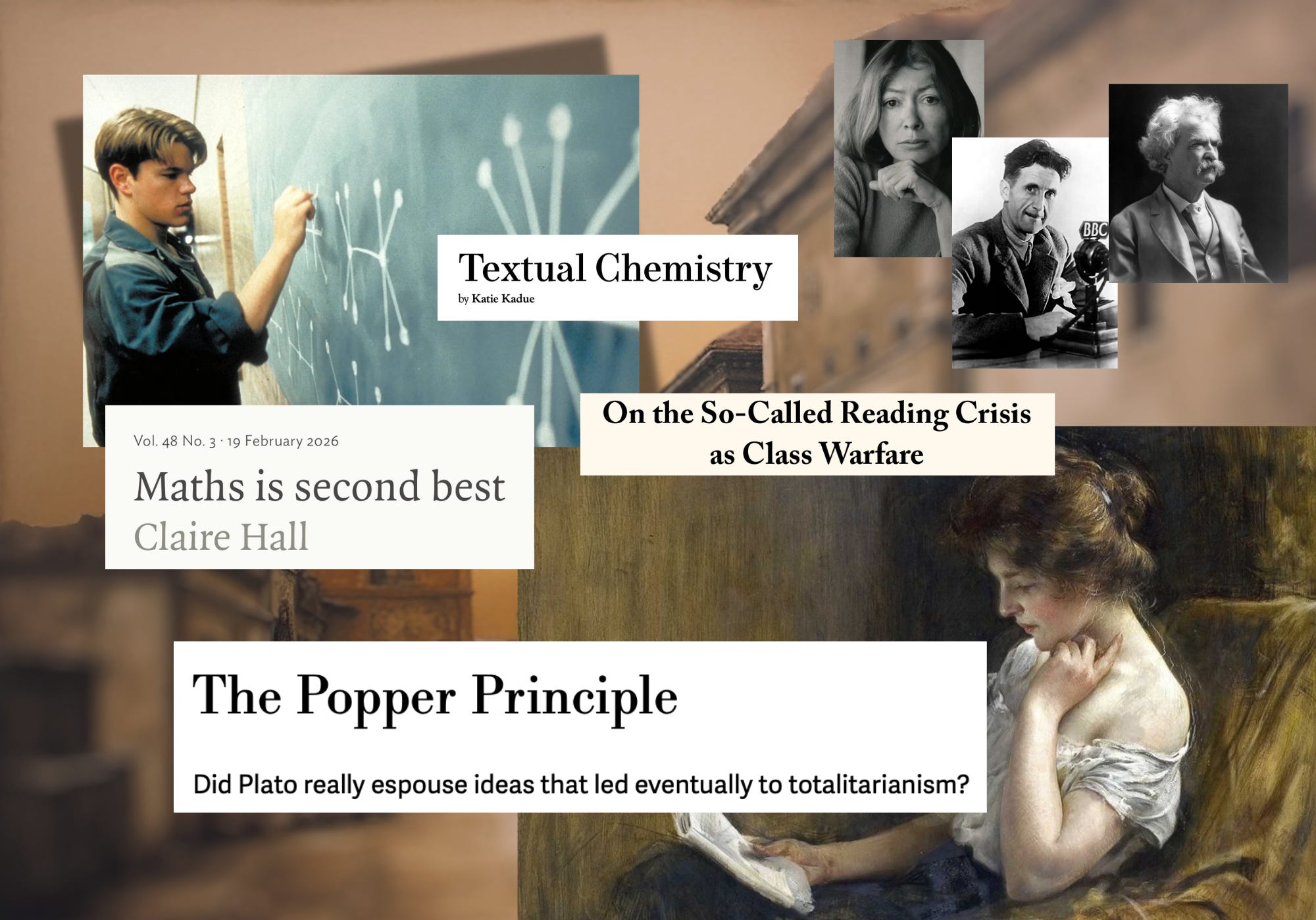
It’s been a few weeks since I’ve shared one of these reading guides! With the turn of the new year, life has expectedly grown full and commitments have accumulated into mountains, so I haven’t been able to assemble them as regularly. But moving forward, to ensure that I keep sharing my readings with you guys, I’ll likely keep these shorter and present just the tip of the iceberg — ideally, three classics and three contemporary pieces — which, I honestly think will fare better anyway, as you’ll have less to scour through and more to engage with.
Anyway, thanks for sticking by me! Without further ado, here are some of the best pieces I read in February. Enjoy.
Featured this week:
Three classic essays —
By Mark Twain, George Orwell, and Joan Didion.
Seven contemporary essays —
Popper versus Plato on the open society and the rise of dictatorship; light and paying attention via Caravaggio and Georges de La Tour; Aristotle’s idea of true leisure versus modern productivity culture; Archimedes as a bridge between abstract mathematics and physical experimentation; the “reading crisis” as class warfare in access to culture; clichés as living language that can still generate meaning; the call for working-class writers to document their own lives.
This week’s list spans —
Lit Hub, Harper’s, The American Scholar, Liberties, London Review of Books, and Jacobin.
About The Weekly Reading Guides: A curated selection of the best essays, op-eds, and articles from great — and often overlooked — corners of the internet and media. I choose what I’d want to read — literary essays on science, literature, philosophy, society, culture, and anything else that gets under my skin. My goal is to spare you the tension headache of figuring out what’s worth your time and lend some meaning to the egregious amount of time I already spend doing it. If your life is full and attention finite, read the blurbs and follow your curiosity.
Each guide also includes a This Week’s Classic Essays section, pairing canonical texts with guiding questions for deep reading — to mix up current reads with foundational texts. In previous guides, these have included Orwell, Wilde, James, Woolf, Sontag, and more.
Read previous guides:


More from the slow philosophy:


[Feb 1 - Feb 28, 2026]
This Week’s Classic Essays

“Corn-Pone Opinions” - Mark Twain (1901)
One of my favorite essays of all time. Mark Twain argues that most people do not form their opinions independently — they adopt the views of those around them. Twain uses the idea of “corn-pone” as a metaphor for social validation and to explain how people conform to group opinions for social reward. Corn-pone is a simple Southern food made from cornmeal—basically a small cornbread cake. In the essay, Twain recalls hearing a Black laborer in the American South say that a person’s opinions depend on where they get their “corn-pone.” The idea is that if someone gives you corn-pone (food, approval, or livelihood), you tend to agree with them or adopt the same opinions. People repeat popular opinions because it brings acceptance, praise, or belonging — the same is true in fashion, politics, religion, and morals — all of which are heavily influenced by group conformity rather than individual reasoning. Twain criticizes society’s tendency toward intellectual laziness and emphasizes how powerful social pressure is in shaping beliefs.
George Orwell - Such, Such Were the Joys (1952)
Reflecting on his treatment at an English preparatory school called St. Cyprian’s, Orwell recounts the harsh discipline, rigid class hierarchy, and emotional cruelty he experienced as a scholarship student among wealthier boys, and explores how the school system reinforced class divisions in early 20th-century England and created a culture of fear, shame, and competition. Written subtly and without any didacticism, Orwell describes the impact of these institutional conditions upon students to accept authority and social inequality while suppressing honesty and individuality. Any time I read an Orwell essay, I get one step closer to understanding how this man came to write 1984.
7000 Romaine, Los Angeles 38 - Joan Didion (1968)
Joan Didion examines the strange, secretive mythology surrounding the reclusive billionaire Howard Hughes — a man whose stories, in her time, circulated with a kind of hushed admiration. In her usual way, Didion uses Hughes to delve briefly into the idea of the American hero. Howard Hughes is not the figure we typically imagine when we think of American heroism. We think instead of Abraham Lincoln, Rosa Parks, Neil Armstrong, and Captain America. But in his own era, Hughes functioned as a kind of concealed American hero — someone few would openly name as their model, yet attracted the admiration reserved for heroes. For Hughes, wealth eventually ceased to be the point and what mattered was the freedom it afforded him — the ability to do whatever the hell he pleased. In that sense, he did embody a particular American ideal — a vision of heroism rooted not in virtue or sacrifice, but in absolute, unhinged, I-don’t-give-a-flying-fuck sort of autonomy.
February’s Best Pieces of Writing
Note: My guides span every corner of thought. Each brings its own light. The aim is to read widely, think critically, and notice where ideas meet and where they part. No school of thought should be a fan club. Accountability, nuance, and the ability to take compassionate, principled stances are the only grown-up postures in life, society, and culture. Let’s think for ourselves and find common ground.
The Popper Principle — The American Scholar
Basically big argument between two philosophers — one ancient, one modern — over what kind of society is best. Karl Popper, a 20th-century philosopher who lived through the rise of Nazism, believed that good science works by trying to disprove ideas rather than to prove them. He called this idea “fallibilism,” which means: we might be wrong, so we should constantly test and question our beliefs, and he thought this mindset shouldn’t apply only to science, but to politics as well. While watching totalitarian governments like Nazi Germany take over Europe, Popper argued that their ideas weren’t completely new — some of their roots could be traced back to Plato. In The Republic, Plato describes an ideal society ruled by “philosopher-kings,” divided into strict social classes, and whenever necessary, held together by “noble lies” to keep people in their place — and maintain structure and order. This kind of rigid, controlled society — where leaders claim special knowledge and discourage change — looked a lot like modern dictatorships. Not everyone agrees with Popper’s reading of Plato, of course — many think Plato is more open-ended and meant to spark discussion, and I wouldn’t as far as saying that Plato gave birth to dictatorship but one has to agree with Popper that a “closed society” tries to stop change and suppress debate, while an “open society” depends on free discussion, questioning authority, and accepting that we might be wrong.
Out of Light — Harper’s Magazine
The essay compares two Baroque painters — Caravaggio and Georges de La Tour — to explore how light, darkness, and attention shape both art and human experience. The author reflects on time spent in Rome seeing Caravaggio’s dramatic paintings, where sharp beams of light cut through darkness to capture moments of intense action and emotion, almost like a single cinematic frame. Caravaggio’s work feels theatrical and explosive, emphasizing conflict and revelation. In contrast, La Tour’s candlelit scenes are intimate and meditative, focusing on stillness and on everyday people softly illuminated in the darkness. Through these artists, the essay argues that attention itself — really looking at something with care —is a form of love and a way of making ordinary moments feel meaningful or sacred. The magic of beautiful light (like in Rome) might actually come from slowing down and truly noticing the world around us.
In Search of the Leisure Class — Liberties Journal
I’ve written about this in my essay In Praise of Gazing at the Ceiling, cited Bertrand Russel’s essay on the topic in the past. Agnes Callard’s essay here argues that modern society misunderstands leisure. We think life consists of work and rest — we work to survive and then rest to recover — but Aristotle believed there is a third kind of activity: leisure (scholē) — the real purpose of life. Leisure is not relaxation or entertainment but a serious activity done for its own sake — thinking, learning, or deeply engaging with ideas all fall under the umbrella. Callard says modern people rarely experience this kind of leisure because we convert our time either into productivity (work) or recovery (rest). The current climate demands constant attention, urgency, and output, leaving little space for reflective intellectual life. She suggests that universities and students should be the place where true leisure exists, because studying philosophy, literature, and ideas can be valuable not as preparation for jobs but as a meaningful activity in itself. Sadly, even the humanities seem to be reserved for the elite — and modern society seems to be moving away from them. The deeper problem she raises — first noticed by economist John Maynard Keynes — is that even if society solved the economic problem of survival, we still wouldn’t know what to do with our free time. Learning how to use time meaningfully, rather than merely working or relaxing, is modern life’s real challenge.
Maths is the Second Best - London Review of Books
The article reviews a biography of the ancient Greek mathematician Archimedes and explains why he was unusual among thinkers of his time. It begins with the story of the Archimedes Palimpsest, a medieval prayer book discovered to contain a hidden text called Method of Mechanical Theorems, a lost work in which Archimedes wrote to the scholar Eratosthenes about how he discovered new mathematical ideas by using physical experiments with balances, levers and models. This showed that he didn’t just imagine abstract geometry but tested ideas using real objects, suggesting a close link between mathematics and the physical world. The article also discusses famous stories about him—like shouting “Eureka!” after figuring out how to test whether a gold crown was pure by measuring water displacement, building war machines to defend Syracuse, and possibly inventing devices such as giant claws to flip Roman ships—though many of these stories may be exaggerated or uncertain. In ancient Greek culture, intellectuals were usually expected to focus on abstract thinking, while practical crafts were considered low-status work done by slaves or artisans, so Archimedes was unusual for combining high-level mathematics with engineering and experimentation. Philosophically, earlier thinkers like Plato saw mathematics as a way to access a higher, perfect reality, while Aristotle treated it mainly as a tool for studying nature; Archimedes took a different approach by treating mathematics and the physical world as equally real and useful for understanding each other, using physical experiments to inspire mathematical discoveries. The rediscovered manuscript helps historians see this side of his thinking more clearly, showing that Archimedes pioneered a style of reasoning that linked theoretical mathematics with hands-on experimentation, an approach that still influences how scientists and mathematicians work today.
On the So-Called Reading Crisis as Class Warfare - Lit Hub
Similar to the essay about the leisure class above, Eunsong Kim argues that the widely discussed “reading crisis” is a class issue, not a cultural decline in literacy. Drawing on Pierre Bourdieu’s theory that cultural tastes reflect social class, she suggests that reading is increasingly becoming a marker of elite status rather than a common public practice. As public arts education is defunded and education is pushed toward “useful” and job-oriented knowledge, deep reading — literature and the humanities — is treated as impractical, especially for ordinary people. But luxury brands and elite institutions continue to turn books and literary culture into exclusive cultural capital, hosting salons and prizes that position reading as a refined activity for the wealthy. The writer connects this dynamic by pointing to figures like Andrew Carnegie, who promoted libraries for workers but insisted their reading focus on practical knowledge rather than literature or philosophy — forms of learning he reserved for elites. In her view, contemporary education policy continues this pattern. The working class is encouraged to pursue practical, employable skills, while the rich retain access to the humanities, reflection, and cultural life. As a result, reading itself risks becoming a luxury sign of class privilege. Kim concludes that the solution is not to encourage individuals to read more but to rebuild public access to the arts, culture, and education, so that reading and intellectual life are not restricted to those with time and wealth.
Textual Chemistry - Harper’s
Katie Kadue’s essay argues that clichés aren’t dead language but can still contain meaning and creative energy if we pay close attention to them. Writers and teachers usually treat clichés as phrases to avoid because they seem worn out and thoughtless. But Kadue, drawing on the critic Christopher Ricks, shows that even supposedly “dead” phrases can produce surprising connections when carefully examined. For example, when George Orwell mocked clichés like “Achilles’ heel,” “melting pot,” and “acid test,” Ricks noticed that the phrases interact with one another in interesting ways, almost creating poetry accidentally. This kind of close reading — careful attention to details in language — reveals that clichés still carry echoes, associations, and possibilities. Kadue also shows that great writers can revive clichés rather than simply avoid them. She points to Bob Dylan, who transforms the cliché “seen better days” into something fresh by slightly changing it (“I see better days and I do better things”). The essay concludes that language is partly self-generating: phrases influence each other and can create meaning almost mechanically. But the role of the critic or writer is to notice and guide these interactions, not simply reject familiar language. Instead of treating clichés as useless, Kadue suggests we should see them as raw material that thoughtful writers and readers can reshape into new meaning.
Go Left, Young Writers! - Jacobin
This Jacobin piece looks back at a 1929 manifesto by socialist writer Mike Gold, “Go Left, Young Writers!,” which argued that American literature and media were dominated by elites and failed to represent working-class life honestly. Gold’s main point was that writing isn’t a mystical practice reserved for geniuses but a form of labor like any other, and workers should write their own stories (diaries, poems, fiction) to show society what life looks like from the bottom up. The article explains how the Great Depression proved Gold’s critique of the rich, helped fuel a short-lived “proletarian literature” movement, and created outlets like New Masses and The Anvil that published multiracial working-class writers, including major Black authors like Richard Wright and others tied to the Harlem Renaissance. It also argues that New Deal programs like the WPA’s Federal Writers’ Project both gave jobs and helped document America (including collecting interviews with formerly enslaved people) and shaped later cultural breakthroughs. Today’s workers still face exploitation and political propaganda. The writer urges them to “pick up the pen” again — to write about jobs, rent, protests, and daily life, and to share it.
If you read any of the essays in full, shoot me a message to discuss it!
Can't wait to finish painting my house, and sit down with a glass of wine to read those essays!
Beautifully written