


NOTE: This is the last reading guide of the year. A postcard featuring the best essays and op-eds of 2025 is on the way.
Featured this week:
Two classic essays — by Susan Sontag and T. S. Eliot.
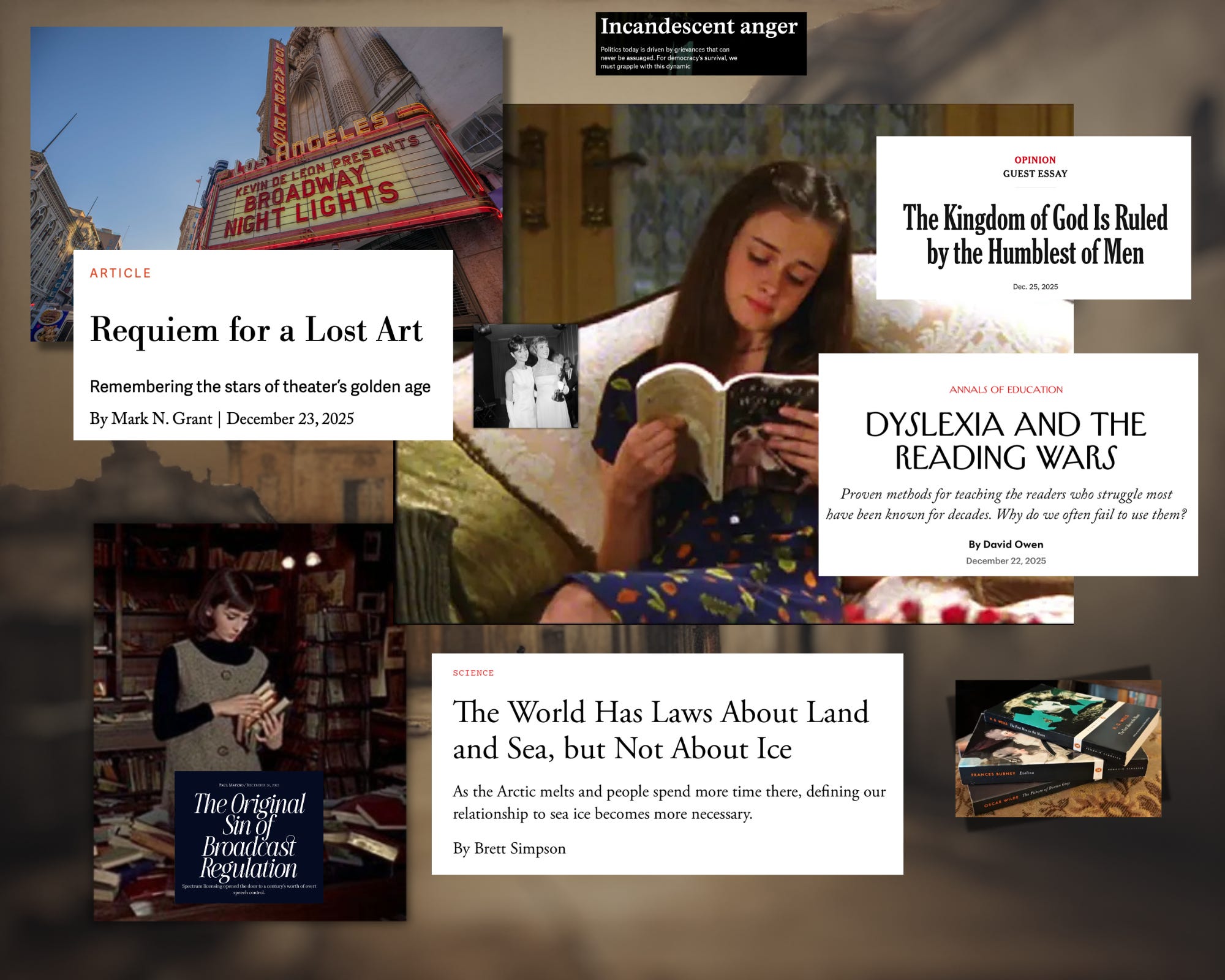
Alongside them, contemporary op-eds on:
Why anger has become a political identity; how the way we teach reading can shape a child’s entire life; what disappears when art isn’t preserved; why climate change creates legal and ethical problems we’re unprepared for; a vision of power rooted in humility rather than control; what happens when our social skills weaken; and a historical look at how media regulation has shaped free speech.
Bonus:
Two reflective pieces—from J.D. Daniels and William Zinsser.
This week’s list spans The New York Times, The Atlantic, Aeon, The American Scholar, and The Dispatch — both free and paywalled.
About The Weekly Reading Guide series: A curated selection of the best essays, op-eds, and articles from great — and often overlooked — corners of the internet and media. For readers who don’t have time to scour online newsstands, are tired of the same circulating stories, and want thoughtful engagement with current cultural, social, political, literary, and artistic conversations.
Each guide also includes a This Week’s Classic Essays section, pairing canonical texts with guiding questions for deep reading — to mix up current reads with foundational texts.
Read previous week’s guide:

More from the slow philosophy
About the Monthly Postcards series: Each month, I share an archive of journal entries, mini-essays, and curated art, books, films, poetry, and music. Read the latest:

About the Letters series: Every quarter, I share a thematic syllabus for deeper living, reading, and self-study. Read the latest:


[Dec 22 - Dec 28, 2025]
Preface: It has been reported that we are living in an era of cognitive and literacy decline. We need to work together to normalize content that protect us from the brain rot of the modern scroll, depleting critical thinking skills, the fading practice of deep reading, and the general decline of the humanities — none of which we can afford. As part of the good fight, I have been putting together these weekly reading guides as well as monthly postcards with curated recommendations of the most nourishing, expansive media content I encounter.
This Week’s Classic Essays
“Against Interpretation” - Susan Sontag (annotated link) (1964)
Sontag says we spend too much time explaining art instead of actually experiencing it. If Oscar Wilde warned against turning art into realism, and Henry James emphasized careful perception (both were read together and discussed in Volume Five of this series), Sontag pushes the idea further. She argues that constantly asking “what does this mean?” takes away from how art feels and affects us. It flattens its emotional and sensory power. Art, she says, isn’t a puzzle to solve, but something to notice and experience. Like Wilde, she defends art’s imagination and sensory power, asking readers to slow down and pay attention. Note: first published in 1964; later collected in a book: link to book.
“Tradition and the Individual Talent” - T. S. Eliot (1919)
Eliot argues that great art is never created in isolation. Every new work is shaped by what came before it. In that, writers and artists are always in conversation with the past, whether they realize it or not. “Tradition,” for Eliot, doesn’t mean copying old styles but it does mean deeply knowing the works that came before and understanding how a new piece of art changes the meaning of that tradition as a whole. He also challenges the idea that art should express the artist’s personal feelings. Instead, he says the artist’s job is to shape emotion into something clear, impersonal, and lasting. The essay asks readers to see art not as self-expression, but as a careful act of craftsmanship shaped by history.
Critical Reflections:
Sontag asks us to experience art without over-explaining it, while Eliot reminds us that art comes from a long tradition. When you encounter a work of art, what helps you connect more—letting yourself feel it first, or learning its background?
Sontag worries that interpretation can drain art of its power.
Are there areas of your life — not just art — where explaining or analyzing too much might be getting in the way of direct experience?Both Sontag and Eliot are writing against habits they see as harmful to art.
What habit — of reading, watching, or consuming culture — do you think most gets in the way of enjoying art today?
I previously shared essays by Oscar Wilde and Henry James, which offer contrasting views on what constitutes art and how it should be approached. You can find them below.

Last Week’s Best Pieces of Writing
Note: My guides span every corner of thought. Each brings its own light. The aim is to read widely, think critically, and notice where ideas meet and where they part. No school of thought should be a fan club. Accountability, nuance, and the ability to take compassionate, principled stances are the only grown-up postures in life, society, and culture. Let’s think for ourselves and find common ground.
Dyslexia and the Reading Wars - The New Yorker
This piece explains dyslexia as a common difficulty with reading that can cause lifelong academic and emotional harm — but also argues that much of the damage is preventable with the right teaching. It follows the author’s niece Caroline, who went from barely being able to read in early elementary school to earning a Ph.D. in gravitational-wave physics, thanks to early diagnosis and “structured literacy” instruction that teaches decoding (the relationship between letter and sound) explicitly and with tons of practice. The article critiques popular “whole language” or cueing approaches that encourage kids to guess words from context or pictures. Research on how the brain reads supports a more phonics-based decoding — especially for dyslexic students. Poor reading instruction can lead to shame, misbehavior, dropout, and even incarceration, while effective programs (like New York City’s newer public “literacy academies”) can quickly transform children’s confidence and futures. Reading isn’t natural like speaking, and must be taught systematically, and doing so early can change lives.
Requiem for a Lost Art - The American Scholar
The article says that even though it feels like the internet has preserved almost everything — books, music, movies, photos — there’s one huge gap: we barely have any real recordings of what the greatest American stage actors were like before TV and modern filming, so their legendary performances have mostly vanished from living memory. Back then, Broadway stars were famous nationwide, but theater is naturally fleeting, and written reviews don’t “show” future generations what made those actors special. As movies and then television took over, acting styles changed, Broadway leaned more on screen celebrities, and the old larger-than-life stage craft faded. Now, we’re left with word-of-mouth stories, names, and a cultural amnesia about an era that once meant a lot.
The World Has Laws About Land and Sea, but Not About Ice - The Atlantic
I had a diplomat once come to our foreign policy classroom in DC, who told us that he once asked President Obama what was the one thing that kept him up at night: and Obama said, “climate change.” The article explains that as Arctic sea ice melts and ships and industries move north, the world has no clear laws about how to protect or govern ice, even though it’s crucial for the climate. Current rules treat ice awkwardly as either land or sea, which doesn’t work because sea ice is constantly forming, melting, and moving. It needs its own set of laws. Some scholars actually argue that the only way to protect it is to give sea ice legal personhood — the right to exist and be defended in court — so someone could legally speak for it and limit harmful activities like shipping and pollution. Without new legal protections, growing Arctic activity will speed up ice loss and worsen global climate impacts — a phenomenon that is already drastically affecting lives and will continue to do so.
The Kingdom of God Is Ruled by the Humblest of Men — The New York Times
The essay explains that Christianity teaches a radically different idea of power through Jesus and the “kingdom of God,” which is not about dominance, wealth, or control but about humility, service, mercy, and love for the weak and forgotten. Jesus overturned normal ideas of greatness by teaching that true leadership comes from serving others, even enemies, and by caring for those society ignores. The author argues that this vision has shaped history but is often betrayed when Christians become judgmental, political, or obsessed with rules instead of compassion and healing. God’s kingdom, the essay says, is already present but not yet complete, growing slowly, and it depends on whether Christians actually live out Jesus’ values of reconciliation, self-sacrifice, and love rather than seeking worldly power.
Your Social Muscles Are Wasting Away. Here Is How to Retrain Them. — The New York Times
The essay argues that many people today are losing basic “social muscles” because modern life encourages independence, convenience, and avoiding friction, which leaves us lonelier and less able to rely on one another. Drawing on her experience living in an intentional shared household, the author explains that strong community requires practicing compromise, putting relationships ahead of personal preferences, and addressing conflicts honestly instead of avoiding them. These habits can feel uncomfortable at first, like exercising weak muscles, but they help rebuild trust, connection, and mutual support. Her message is that relearning how to live closely with others isn’t just practical in a strained world but essential for human well-being and resilience.
The Original Sin of Broadcast Regulation - The Dispatch
This article argues that the U.S. system of regulating broadcast media has undermined free speech for nearly a century by treating radio and television differently from print. The author explains that government licensing of broadcast spectrum, begun in the 1920s, allowed politicians to control and punish speech they disliked, something the First Amendment was designed to prevent. Through examples ranging from early radio preachers to presidents like Roosevelt, Kennedy, and Nixon, the essay shows how broadcast regulation — especially rules like the Fairness Doctrine — was repeatedly used for partisan censorship. The author concludes that government ownership and licensing of spectrum was a mistake, and that ending broadcast licensure in favor of clear property rights would better protect free speech and bring broadcasting in line with America’s original free-press ideals.
Two special entries:
Lyrical Nonfiction
Dream Diary - The Paris Review (J.D. Daniels)
This is a long series of vivid, unsettling dream fragments that move through fear, family conflict, grief, desire, shame, and moments of wonder. The dreams repeatedly return to the narrator’s parents — especially a violent, domineering father — and to the narrator’s longing for safety, understanding, and connection, often mixing childhood vulnerability with adult awareness. The dreams mix absurd humor, fear, violence, grief, family conflict, longing, and flashes of beauty, with recurring images of the author’s parents, especially his father, as sources of threat, judgment, or confusion. Taken together, the dreams don’t tell a single story but instead create an intense portrait of anxiety, memory, anger, and vulnerability, revealing how dreams can express truths that feel impossible to say clearly while awake.
A Christmas Dinner - The American Scholar (William Zinsser)
originally published in 2010, republished in 2025
In this essay, William Zinsser (author, The Elements of Style) reflects on finding a menu from his Christmas dinner in 1944, when he was a young Army sergeant living in harsh conditions in wartime Italy. The carefully typed menu and a thoughtful message about faith, peace, and shared values offered comfort and dignity to soldiers far from home, reminding them of what they were fighting for. Looking back decades later, Zinsser compares World War II — which he calls the last “good” war — with later, more ambiguous conflicts, and reflects on how the “greatest generation” label faded over time. He concludes that every generation of soldiers who serve and sacrifice deserves respect, and offers a simple message of gratitude and goodwill to all who fight the nation’s wars.
Critical Reflections
Many of these essays describe systems — political, educational, technological, religious, cultural — that were meant to serve people but now distort behavior, meaning, or trust. Where do you see the biggest gap between an institution’s stated purpose and its real effects on human lives?
Across topics as different as anger, literacy, climate law, faith, and community, these writers keep returning to the same quiet theme: attention. What we notice, what we ignore. What did these pieces ask you to pay attention to?
Thank you for your incredible engagement with this series. It has been a privilege putting these together. We’ll continue into the new year with more curations.
Happy New Year!
Tulipe
I love that you lead me on a journey of wonderful work!
i love these posts. they've led me to so many fascinating essays and articles! this is such an interesting and varied list, thank you for sharing!